
What Is NPS? The Complete Guide to Net Promoter Score [2026]
NPS is the most widely used loyalty metric in the world, and also the most frequently misused. Indeed, the score means nothing without follow-up. Here is how to use it properly.
![What Is NPS? The Complete Guide to Net Promoter Score [2026]](/img/knowledge/nps.svg)
- NPS measures willingness to recommend on a 0-10 scale. Promoters (9-10) minus Detractors (0-6) gives you the score. Passives (7-8) are excluded from the calculation but should not be excluded from your attention.
- An NPS of 30 in telecoms is strong. The same number in SaaS is mediocre. Context is everything.
- Instead, the score itself is the least important part. The follow-up conversation with Detractors, the root cause analysis, the systemic improvements, that is where value is created.
- Among the companies we work with, the ones that close the loop within 48 hours consistently outperform. Tracking the number alone is not enough.
Fred Reichheld published "The One Number You Need to Grow" in Harvard Business Review in 2003. Two decades later, NPS is the most widely used customer loyalty metric in the world. It is also the most frequently misused. For example, companies track the score, debate whether 32 is better than 28, and present dashboards at quarterly reviews. Then they do nothing with the feedback.
The score is the least important part of NPS. Rather, the conversations it triggers, the root causes it surfaces, the improvements it drives, that is where the value lives.
How NPS Works
One question:
"How likely are you to recommend [company/product] to a friend or colleague?"
Customers answer on a 0-10 scale and fall into three groups:
- Promoters (9-10): Loyal advocates who actively recommend you. Your growth engine.
- Passives (7-8): Satisfied but unenthusiastic. Vulnerable to competitors. Rarely recommend.
- Detractors (0-6): Dissatisfied customers who can damage your brand through negative word of mouth.
Scale: 0-10 Measures: Long-term loyalty and recommendation intent Best for: Strategic overview, benchmarking, churn identification Typical frequency: Quarterly (relational) or post-interaction (transactional)
The Calculation
NPS = % Promoters − % Detractors
Passives are excluded from the formula but should not be excluded from your strategy.
Example
500 customers surveyed, 200 responses:
| Group | Score | Responses | Share |
|---|---|---|---|
| Promoters | 9-10 | 100 | 50% |
| Passives | 7-8 | 60 | 30% |
| Detractors | 0-6 | 40 | 20% |
NPS = 50% − 20% = +30
What the score range means
- Below 0: More Detractors than Promoters. Investigate root causes.
- 0-30: Positive but room to improve.
- 30-50: Strong. Better than most competitors in most industries.
- 50-70: Excellent. Customers are actively advocating for you.
- Above 70: World-class territory.
Industry Benchmarks
An NPS of 30 in telecoms is strong. The same number in retail is mediocre. Context is everything.
| Industry | Average NPS |
|---|---|
| Retail | 54 |
| Technology / SaaS | 30 |
| Finance and Banking | 34 |
| Insurance | 34 |
| Telecommunications | 24 |
| Healthcare | 38 |
| Hospitality and Travel | 39 |
These are averages that vary by source and year. Consequently, your own trend over time is more meaningful than any external benchmark. For the full benchmark breakdown: NPS Benchmarks 2026.
Relational vs. Transactional NPS
Relational NPS
Sent periodically (quarterly or biannually) to the full customer base. Measures the overall health of the relationship. Used for strategic planning, C-suite reporting, and tracking trends.
Transactional NPS
Triggered immediately after a specific interaction, a purchase, a support case, an onboarding session. Measures satisfaction with that specific experience. Used for touchpoint improvement and agent performance.
Transactional NPS typically runs 10-15 points higher than relational NPS because it captures feedback at a moment of engagement. Therefore, only compare like with like.
Implementing NPS
- Define the purpose. What are you trying to learn? The overall relationship health? Satisfaction with a specific product? Onboarding experience? The purpose determines who you survey, when, and how.
- Choose your channel. Email (most common for B2B), in-app (high context, ideal for SaaS), SMS (high open rates), or embedded in email (NPS scale directly in the body, can increase response rates by 20-30%).
- Keep the survey minimal. The NPS question plus one open-ended follow-up: "What is the main reason for your score?" That is sufficient. Every additional question reduces response rates without proportionally increasing insight.
- Segment the results. Your overall NPS hides more than it reveals. Break it down by customer tier, product line, geography, tenure (new vs. established), and stage in the customer journey.
- Close the loop. This is the step that separates companies that measure NPS from companies that use NPS. Without follow-up, NPS is a data collection exercise. With follow-up, it becomes a management system.
Closing the Loop
Detractors (0-6): Contact within 48 hours. Phone call, not email. Listen. Acknowledge. Offer a specific resolution. Many Detractors can be recovered, but only if you act fast.
Passives (7-8): Send targeted communication within 5 days. Ask: "What would it take for us to earn a 9 or 10 next time?" Small improvements often move Passives into Promoter territory.
Promoters (9-10): Thank them. Ask if they would write a review, join a case study, or refer a colleague. Promoters are your cheapest acquisition channel.
As a result, companies that systematically close the loop see NPS increase by up to 40% over 12 months compared to those that only measure. For the complete close-the-loop playbook: Close the Loop.
What We See in Practice
Among the B2B companies we work with, the biggest NPS mistakes are consistent:
Treating NPS as a vanity metric. The score goes into a quarterly presentation. Nobody calls the Detractors. Moreover, nobody investigates why mid-market accounts score 25 points lower than enterprise accounts. The data exists but drives no action.
Ignoring the open-ended responses. The quantitative score tells you something is happening. The text responses tell you why. Companies that skip qualitative analysis are throwing away the most actionable part of NPS.
Surveying at the wrong moment. Sending NPS right after invoicing, right after a known service disruption, or exclusively to customers who just had a positive interaction skews results and undermines trust in the data.
Not segmenting. A company-wide NPS of +32 sounds fine. But if enterprise accounts are at +55 and mid-market accounts are at +8, you have a serious problem that the aggregate hides.
Common Mistakes
- Measuring without acting. Data without action is waste. Worse, customers who give feedback and see nothing change become more dissatisfied.
- Comparing across industries. NPS of 30 is excellent for insurance, disappointing for retail.
- Survey fatigue. Surveying too frequently erodes response rates and damages the relationship.
- Response rate bias. If only the very happy and very unhappy respond, your data is skewed.
- Gaming the score. Account managers who ask customers to "give us a 9 or 10" produce data that is useless.
NPS and Growth
Reichheld and Bain & Company's research found that NPS leaders in most industries grow twice as fast as the average. The mechanism is straightforward:
- Promoters repurchase more and spend more over time
- Promoters refer new customers, lowering acquisition costs
- Fewer Detractors means less negative word of mouth and lower churn
In short, an NPS increase is not a metric improvement. It reflects real changes in the customer experience that drive commercial results.
For the business case: Customer Satisfaction and Revenue.
NPS Alone Is Not Enough
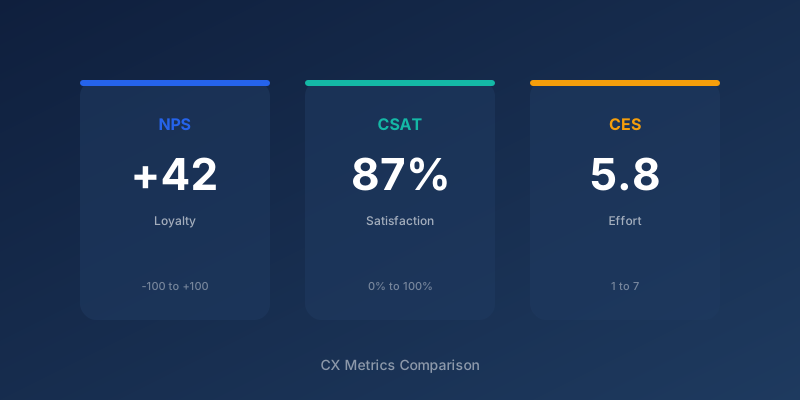
NPS tells you whether customers are loyal. It does not tell you why they are dissatisfied with a specific touchpoint (that is CSAT), or whether your processes are too hard to navigate (that is CES).
The strongest CX programmes use all three: NPS for strategic overview, CSAT for touchpoint diagnostics, CES for friction reduction. For the full comparison: NPS vs. CSAT vs. CES.
Start with NPS. Close the loop. Segment the data. Act on what you find. That is what turns a survey into a growth engine.
Frequently Asked Questions
Above 0 is positive. Above 30 is good. Above 50 is excellent. However, those thresholds are meaningless without industry context. For example, an NPS of 25 in telecoms is outstanding. The same score in premium retail is below average. Always benchmark within your industry, and prioritise your own trend over external comparisons.
Relational NPS: quarterly or biannually to the full customer base. Transactional NPS: immediately after specific interactions. The key constraint is survey fatigue, no customer should receive more than one survey per quarter.
Relational NPS measures the overall health of the customer relationship. Transactional NPS measures satisfaction with a specific interaction. Relational is strategic, transactional is tactical. Transactional NPS typically runs 10-15 points higher because it captures satisfaction at a moment of engagement.
Yes, and it is arguably more valuable in B2B than B2C because the revenue at stake per account is higher. The challenge is deciding who to survey: the decision-maker, the end user, or both. Typically, B2B response rates tend to be lower, but the data quality is higher.
Do not ignore them. Passives are the silent majority in most NPS distributions. They are not angry enough to leave loudly. But they are not loyal enough to stay when a competitor makes an offer. A small investment in understanding what would make them Promoters yields outsized NPS gains.
Ready to know what your customers actually think?
SurveyGauge helps Nordic B2B companies move from gut feeling to data-driven CX decisions.
SurveyGauge Team
Customer Experience Experts
SurveyGauge-teamet hjælper virksomheder med at måle og forbedre kundetilfredshed via professionelle surveys, analyser og rådgivning.
You might also be interested in
View all articles
What Is CSAT? Guide to Customer Satisfaction Score
CSAT is the most direct satisfaction metric you can use, but it is also the most abused. Therefore, here is how to deploy it properly, when to trust it, and when it misleads.
NPS vs. CSAT vs. CES: Which Metric Should You Choose?
NPS, CSAT, and CES measure different things. Choosing the wrong one for the wrong situation gives you data that looks useful but misleads. Therefore, here is when to use each, and why the best programmes use all three.
