How to Reduce Churn: 7 Strategies That Work
Churn is the most expensive problem most B2B companies underestimate. Here are seven strategies that work, from early warning systems to win-back campaigns, with the numbers behind each.

- Acquiring a new customer costs 5-7x more than retaining an existing one. Every churned account represents lost CLV plus the cost of replacement.
- Moreover, customers decide to leave 60-90 days before they cancel. The signals are visible, declining usage, low NPS, repeated support tickets, if you know where to look.
- First-90-days churn is the most preventable form of churn. Proactive onboarding CSAT tracking reduces it by 30-40%.
- Among the companies we work with, close-the-loop follow-up within 48 hours consistently saves 20-30% of Detractors who would otherwise leave.
The true cost of losing customers
A 10% annual churn rate sounds manageable until you calculate what it actually costs. Most companies look at lost subscription revenue for the period. However, that is 20-30% of the real number.
The full cost of a churned customer:
- Lost Customer Lifetime Value: Not one quarter of revenue. All remaining future revenue from that account.
- Replacement cost: Acquiring a new customer to fill the gap costs 5-7x more than retaining the one you lost (Bain & Company).
- Hidden damage: Churning customers talk. In B2B, where peer recommendations drive 84% of buying decisions, one vocal ex-customer can poison multiple deals.
Profit impact of 5% retention increase: 25-95% (Bain & Company)
Indeed, that number alone justifies every churn reduction effort described below.
To get leadership attention, calculate: churning customers per year x average CLV. For most B2B companies, that number is large enough to secure budget immediately.
When the decision actually happens
Importantly, customers do not churn the day they cancel. Churn decision window: 60-90 days before cancellation
By then, they have already evaluated alternatives, discussed internally, and emotionally disengaged.
The signals are visible if you look:
- Declining product usage or login frequency
- Low NPS score (Detractor, 0-6)
- Repeated support tickets about the same unresolved issue
- Skipping QBR meetings or not responding to account manager outreach
- Silence where there used to be engagement
- Pricing questions or requests for contract flexibility
Strategy 1: NPS as an early warning system
The most effective churn prevention tool is identifying dissatisfied customers before they decide to leave. Specifically, NPS does this directly: willingness to recommend is a strong proxy for future behaviour.
How to implement:
- Quarterly relational NPS to the full customer base
- Automatic Detractor flagging (score 0-6) in CRM
- Account manager contacts every Detractor within 48 hours
- Track churn rate by NPS segment over 12 months
Detractors churn at 4-6x the rate of Promoters. A 10-point reduction in Detractor share has significant bottom-line impact. For the complete NPS follow-up playbook: Close the Loop.
Strategy 2: Fix onboarding with CSAT checkpoints
First-90-days churn is the most preventable form of churn. Customers who do not see early value quietly disengage and leave at the first renewal opportunity.
How to implement:
- CSAT at day 7: Has the customer started successfully?
- CSAT at day 30: Have they achieved their first meaningful outcome?
- CSAT at day 90: Are they fully adopted and seeing ongoing value?
- Proactive outreach to every customer who scores low at any checkpoint
As a result, companies that track and act on onboarding CSAT see 30-40% reduction in first-90-days churn. The mechanism is simple: you reach the struggling customer before they give up.
Strategy 3: Close the loop on negative feedback
Close the loop is the process of following up on every piece of negative feedback with a personal conversation and a real resolution. The Customer Experience Board found that customers who complained and received a professional resolution are more loyal than those who never had a problem.
How to implement:
- Automatic CRM notification on negative NPS or low CSAT
- 48-hour rule: Every Detractor contacted within 2 business days
- Root cause documented in CRM
- Resolution tracked: was the problem fixed?
- Re-survey 30-60 days later to confirm improvement
In our experience, systematic close-the-loop programmes save 20-30% of customers who would otherwise churn. For the detailed framework: Close the Loop: The Complete Playbook.
Strategy 4: Build a Customer Health Score
Individual metrics tell you part of the story. In contrast, a composite Health Score tells you the whole thing.
- Product usage (30-40% weight): Login frequency, feature adoption, activity trends
- Support signal (20-25% weight): Open tickets, resolution time, CSAT scores
- Payment behaviour (15-20% weight): On-time payments, billing disputes
- Engagement (10-15% weight): Email opens, event participation, communication responsiveness
- Sentiment (15-20% weight): NPS score, survey participation, open-ended comment tone
A customer with declining usage, an open support ticket, and a recent NPS of 4 is at severe risk. No single signal would trigger an alert on its own.
How to implement: Define a scoring model, integrate data from product analytics, CRM, and support into a dashboard, and create automatic alerts when a customer crosses below a threshold. Proactive Customer Success outreach on health-score declines stops churn before the customer has decided to leave.
Strategy 5: Understand why customers leave
Knowing the churn rate is not enough. Furthermore, knowing why customers leave is what tells you where to invest.
Exit survey (send to every churning customer):
- What was the primary reason for leaving?
- What would have made you stay?
- What will you use instead?
Exit interviews (for top-tier accounts): A 15-minute phone conversation with a departing enterprise customer reveals more than a hundred survey responses. Have someone senior make the call, not the account manager who owns the relationship.
Churn reasons vary by industry:
| Reason | SaaS | E-commerce | Finance |
|---|---|---|---|
| Price/value | 30-40% | 25-35% | 20-30% |
| Missing features | 20-30% | 15-20% | 10-20% |
| Better alternative | 15-25% | 20-30% | 15-25% |
| Poor experience | 10-20% | 15-25% | 15-20% |
| Own circumstances | 10-15% | 10-15% | 15-20% |
Analyse the patterns. For example, if price/value is the top reason, the fix is not discounting, it is demonstrating value better. If "poor experience" is concentrated in onboarding, the fix is obvious.
Strategy 6: Prioritise by customer value
Not every account justifies the same retention investment. Segment by CLV and allocate resources accordingly:
- High-value Detractors: Senior account manager calls personally. Escalation to leadership if needed.
- Mid-value Detractors: Account manager email with specific offer of a conversation.
- Low-value Detractors: Automated email with self-service resources and a path to escalate.
In SaaS, enterprise accounts are typically 10-50x more valuable than SMB accounts. Investing equal effort in both is a misallocation of resources. This is not cynical, it is honest about where retention investment generates the highest return.
Strategy 7: Win-back campaigns that address the reason
A customer who left is not necessarily gone forever. Win-back campaigns that address the actual churn reason achieve a 20-40% success rate when contact happens within 30 days.
What works:
- Know exactly why they left (from exit survey or conversation)
- Address the specific reason: "We have shipped the integration improvement you mentioned"
- Contact within 30 days. After that, the success rate drops sharply.
- Personal outreach from a senior person outperforms automated emails by a wide margin
What does not work: A 20% discount to someone who left because your product lacked a critical feature. Win-back must address the reason, not bribe the customer back into a situation that will produce the same outcome.
What we see in practice
Among the B2B companies we work with, churn reduction always starts with the same two realisations:
The churn rate hides everything. A company-wide 7% annual churn looks manageable. Yet break it down and you find enterprise at 3% and mid-market at 18%. The aggregate masks a crisis in one segment.
Retention is a system, not a campaign. Companies that reduce churn sustainably do not run one-off retention projects. They build early warning systems (NPS + health score), fix onboarding systematically (CSAT checkpoints), close the loop on every Detractor, and continuously invest in understanding why customers leave.
Measuring churn reduction
Track monthly:
| Metric | What it tells you |
|---|---|
| Monthly churn rate | Headline metric. Segment by tier and product. |
| Revenue churn rate | The financial impact of churn. More important than logo churn for B2B. |
| NPS Detractor rate | Leading indicator. Rising Detractor share predicts rising churn. |
| Close-the-loop rate | % of Detractors contacted within 48h. Operational discipline. |
| Recovery rate | % of contacted Detractors who do not churn. Programme effectiveness. |
| Win-back rate | % of churned customers who return. Last-resort effectiveness. |
Segment everything by cohort, customer tier, and product. An overall rate of 5% can hide a 2% rate in your best segment and a 15% rate in your worst.
For the business case behind churn reduction: Customer Satisfaction and Revenue.
Frequently Asked Questions
Context-dependent. B2B enterprise SaaS should target annual churn below 5-8%. Monthly churn above 3% in SaaS is a crisis. B2C e-commerce naturally runs higher. The number to watch is not just the rate but revenue churn. Losing one enterprise account matters more than losing ten SMB accounts.
Customers decide to leave 60-90 days before cancelling. By the time they send the cancellation email, the decision was made weeks ago. Therefore, the window for intervention is in the preceding signals: declining usage, low NPS, repeated support tickets, silence.
Far more than lost subscription revenue. You lose the remaining CLV, pay 5-7x more to acquire a replacement, and absorb the hidden cost of negative word of mouth. Most companies underestimate true churn cost by 3-5x.
Churn caused by payment failures, expired cards, technical errors, or missed budget approvals, not by a deliberate decision to leave. It typically represents 20-40% of all churn in subscription businesses and is largely preventable with dunning flows and proactive payment reminders.
Yes, with a 20-40% success rate when you contact within 30 days and address the actual churn reason. After 30 days, the rate drops sharply. Offering a discount without addressing the reason is a waste of money.
Ready to know what your customers actually think?
SurveyGauge helps Nordic B2B companies move from gut feeling to data-driven CX decisions.
SurveyGauge Team
Customer Experience Experts
SurveyGauge-teamet hjælper virksomheder med at måle og forbedre kundetilfredshed via professionelle surveys, analyser og rådgivning.
You might also be interested in
View all articles![What Is NPS? The Complete Guide to Net Promoter Score [2026]](/img/knowledge/nps.svg)
What Is NPS? The Complete Guide to Net Promoter Score [2026]
NPS is the most widely used loyalty metric in the world, and also the most frequently misused. Indeed, the score means nothing without follow-up. Here is how to use it properly.
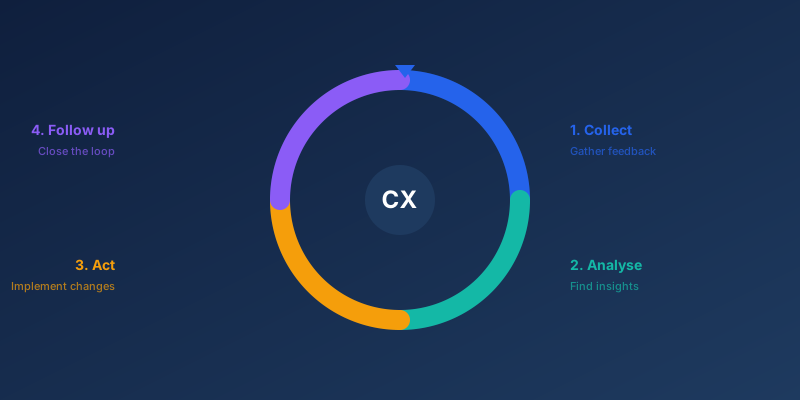
Close the Loop: What Is It, and How Do You Do It?
You sent the survey. Now what? Specifically, close the loop is the practical execution of following up on every response, recovering Detractors, and turning patterns into systemic fixes.