
Customer Satisfaction and Revenue: How to Build the Business Case
Your CFO does not care about NPS. They care about revenue. Therefore, here is how to translate customer satisfaction into the language of retention, expansion, and profit.
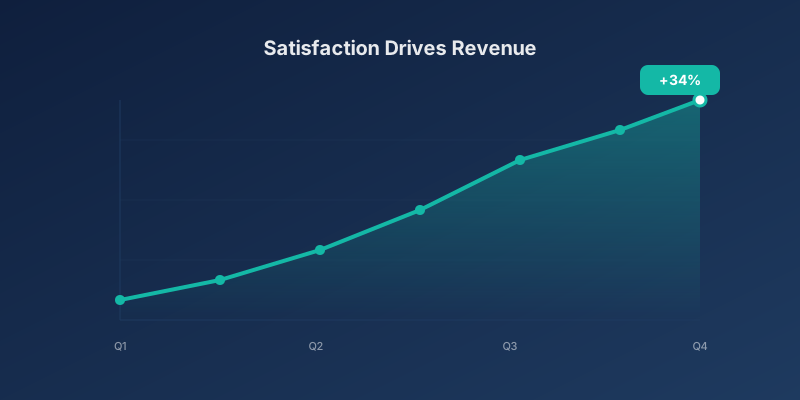
- A 5% increase in retention boosts profit by 25-95% (Bain & Company). That single number makes the business case.
- Promoters spend 3-4x more than Detractors and refer 5-10 new contacts. They are your cheapest growth channel.
- In fact, churn does not just cost lost revenue. It costs the entire remaining Customer Lifetime Value plus the acquisition cost of the replacement. Most companies underestimate this by 3-5x.
- The fastest way to prove CX ROI is a 90-day close-the-loop pilot. Contact all Detractors, measure saved accounts, calculate retained revenue.
The CX team's problem with the C-suite
Customer experience professionals know that satisfaction drives retention, expansion, and referrals. However, the problem is that most of them cannot prove it in financial terms. They present NPS trends and customer quotes. Meanwhile, the CFO wants to see revenue impact and payback periods.
This article is about bridging that gap. Not with theory, but with the specific calculations, research, and frameworks you need to build a business case that finance takes seriously.
The research that matters
Bain & Company: the retention multiplier
A 5% increase in customer retention boosts profit by 25-95%. This is the most cited number in CX, and it holds up. The mechanism is straightforward: existing customers cost less to serve and buy more over time.
Reichheld and NPS leaders
Fred Reichheld's research found that NPS leaders in 11 of 14 industries grew more than twice as fast as their industry average. Admittedly, correlation is strong, causality is debated, but the pattern is consistent.
PwC: the willingness-to-pay premium
PwC's Future of Customer Experience survey found that 86% of buyers are willing to pay more for a good experience. For premium brands, the price premium is typically 13-18%. In B2B, this translates to reduced price sensitivity during renewals.
Temkin Group: Promoter economics
Promoters (NPS 9-10) versus Detractors (0-6):
- Spend 3-4x more
- Recommend to 5-10 contacts
- Have 4-7x higher Customer Lifetime Value
Those are not marginal differences. Indeed, they are the economics that justify every CX investment.
Three calculations for your business case
1. The true cost of churn
Most companies calculate churn cost as lost revenue for the period. As a result, that understates the damage by 3-5x.
Real churn cost = Lost CLV + acquisition cost of replacement
Example:
- 1,000 customers churn per year
- Average CLV: $50,000
- Lost CLV: $50 million
- Replacement cost (typically 1-3x CLV for acquisition + onboarding): $50-150 million
- Total annual churn cost: $100-200 million
That number gets attention in every boardroom.
2. NPS segment revenue analysis
Segment your customer base by NPS score and compare average revenue per segment:
| Segment | Score | Count | Avg. Revenue |
|---|---|---|---|
| Promoters | 9-10 | 500 | $120,000 |
| Passives | 7-8 | 300 | $75,000 |
| Detractors | 0-6 | 200 | $40,000 |
Converting 50 Detractors to Passives generates 50 x ($75,000 - $40,000) = $1.75 million in additional revenue, while reducing churn risk on those accounts.
3. Promoter referral value
If each Promoter generates one referral per year with a CLV of $50,000, and you have 500 Promoters, that is $25 million per year in referral-driven revenue. Even at a conservative 20% referral rate, it is $5 million.
Furthermore, referral revenue is the most profitable revenue you have: zero acquisition cost, shorter sales cycles, and higher retention.
Building the case for leadership
A business case that gets funded has six elements:
1. Baseline: Current NPS, churn rate, CLV by segment, NRR.
2. Cost of inaction: What does it cost every year to not improve? Use the churn calculation above.
3. Investment required: Programme cost including tools, headcount, and training.
4. Expected return: Based on the calculations above and benchmark data from similar companies.
5. Milestones: 90-day quick wins (close-the-loop pilot), 12-month targets (churn reduction), 24-month goals (NRR improvement).
6. Measurement plan: How you will prove the programme is working.
What we see in practice
Among the companies we work with, the business case fails for one of three reasons:
Too abstract. "Improving customer satisfaction will reduce churn" convinces nobody. Specifically, "Our Detractors churn at 34% per year versus 6% for Promoters, representing $2.4 million in at-risk revenue" gets budget approved.
No baseline. You cannot demonstrate improvement without a starting point. Before asking for investment, establish your current NPS by segment, churn rate by NPS category, and CLV by tier.
No quick wins. Leadership wants to see evidence before committing to a multi-year programme. A 90-day close-the-loop pilot provides that evidence.
The 90-day pilot that proves ROI
The fastest path from theory to proof:
- Run an NPS survey. Identify 200-300 Detractors.
- Implement a close-the-loop process: contact every Detractor within 48 hours.
- After 90 days, compare churn rate for contacted Detractors versus a control group of non-contacted Detractors (or historical data).
- Calculate saved accounts x CLV = programme ROI.
This gives you a concrete number for the leadership presentation. In our experience, the ROI of a well-executed pilot typically exceeds 5:1, which is consequently more than enough to justify scaling the programme.
For the churn reduction strategies that follow the business case: How to Reduce Churn.
Frequently Asked Questions
The total revenue a customer generates over the entire relationship. Average order value times purchase frequency times average customer lifespan. In B2B SaaS, doubling CLV has a bigger impact on valuation than doubling new customer acquisition.
Yes. Segment customers by NPS score. Then, track their revenue, churn rate, and referral behaviour over 12-24 months. When you can show that Promoters have 3-4x higher CLV than Detractors, the ROI argument makes itself.
NRR measures whether you are growing revenue within your existing base, through renewals, upsells, and expansion, minus churn and downgrades. Above 100% means you are growing even without new logos. It is the single best indicator of customer satisfaction translated into financial terms.
Bain & Company found that NPS leaders grow 2x as fast as industry average. The correlation is strong but causality is debated. What is not debated: companies that act on NPS feedback grow faster than those that merely measure it.
A structured close-the-loop pilot can demonstrate ROI within 90 days through saved accounts. Systemic impact on churn and CLV typically takes 12-24 months of consistent work.
Ready to know what your customers actually think?
SurveyGauge helps Nordic B2B companies move from gut feeling to data-driven CX decisions.
SurveyGauge Team
Customer Experience Experts
SurveyGauge-teamet hjælper virksomheder med at måle og forbedre kundetilfredshed via professionelle surveys, analyser og rådgivning.
You might also be interested in
View all articles![What Is NPS? The Complete Guide to Net Promoter Score [2026]](/img/knowledge/nps.svg)
What Is NPS? The Complete Guide to Net Promoter Score [2026]
NPS is the most widely used loyalty metric in the world, and also the most frequently misused. Indeed, the score means nothing without follow-up. Here is how to use it properly.

How to Reduce Churn: 7 Strategies That Work
Churn is the most expensive problem most B2B companies underestimate. Here are seven strategies that work, from early warning systems to win-back campaigns, with the numbers behind each.
![Customer Journey Mapping: The Complete Guide [2026]](/img/knowledge/customer-journey.svg)