Customer Journey Mapping: The Complete Guide [2026]
Most journey maps end up as posters on a wall that nobody looks at. Instead, the ones that work start with real customer data, focus on one persona, and lead to specific ownership of specific problems.
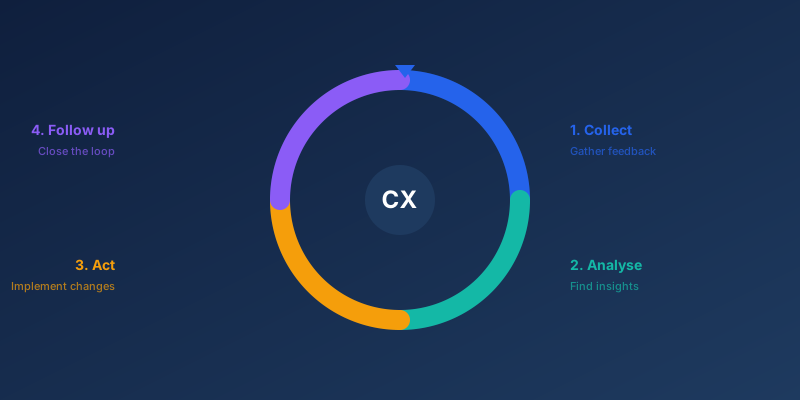
![Customer Journey Mapping: The Complete Guide [2026]](/img/knowledge/customer-journey.svg)
- Journey mapping forces you to see your company the way your customer does, not the way your org chart says.
- Specifically, the maps that drive change include emotions, pain points, and real customer data, not just a flowchart of touchpoints.
- Start with one persona and one journey. Companies that try to map everything at once produce nothing actionable.
- In our experience, the biggest journey mapping insight is always the same: the gaps between departments are where customers suffer most.
Your company looks different from the outside
Every company is organised in departments. Marketing does acquisition. Sales does deals. Support handles problems. Product ships features. Each department optimises for its own metrics.
However, your customer experiences none of this. They experience one continuous journey with your company, and the cracks between departments are where the worst experiences happen. The customer who gets a brilliant sales pitch and then a chaotic onboarding. The loyal customer who considers leaving because changing their billing details requires three emails and a phone call.
Customer journey mapping is the practice of seeing your company the way your customer sees it. Not as departments, but as a sequence of experiences with emotions, expectations, and friction at every step.
What a journey map actually contains
A useful journey map is not a process flowchart. It documents:
- All stages the customer moves through
- All touchpoints where the customer interacts with you, directly or indirectly
- The customer's thoughts, feelings, and expectations at each stage
- Pain points and moments of friction
- Gaps where the customer is left alone and uncertain
Ultimately, the purpose is not to produce a nice visual. It is to find the specific places where your company fails the customer, and to assign ownership of fixing them.
The six stages of most customer journeys
1. Awareness
The customer realises they have a problem. They start searching. At this point they do not care about your brand. They care about their problem.
Touchpoints: Search engines, social media, peer recommendations, industry publications, events
What the customer is thinking: "Who can solve this for me?"
2. Consideration
The customer evaluates options. They compare you to alternatives and form an opinion about whether you understand their problem.
Touchpoints: Your website, product pages, review sites (G2, Trustpilot), demo videos, competitor comparisons, free trials
What the customer is thinking: "Is this the right fit for my situation?"
3. Decision
The customer commits. In B2B, this often involves internal approvals, procurement, and risk evaluation.
Touchpoints: Pricing page, sales conversations, proposals, contracts, checkout
What the customer is thinking: "Can I trust these people with my budget and my reputation?"
4. Onboarding
The customer starts using your product. This is the highest-risk moment for retention. Customers who struggle early rarely recover.
Touchpoints: Welcome communications, onboarding flows, kick-off meetings, documentation, training
What the customer is thinking: "Can I actually use this? Will I see value quickly?"
5. Adoption
The customer uses the product on an ongoing basis. They continuously evaluate whether the value justifies the cost.
Touchpoints: The product itself, support interactions, account management, business reviews, newsletters
What the customer is thinking: "Am I getting what I paid for?"
6. Loyalty and advocacy
Satisfied customers renew, expand, and recommend. Dissatisfied ones leave quietly or, worse, tell others to avoid you.
Touchpoints: Renewal conversations, upsell proposals, NPS surveys, referral programmes, case study requests
What the customer is thinking: "Would I recommend this to a peer?"
How to build your first journey map
Step 1: Define a specific scope
A journey map that tries to cover all customers and all scenarios produces generic insights that help nobody. Pick one specific problem:
- "Why do 30% of new customers churn within 90 days?"
- "Where does our checkout process lose people?"
- "What breaks in the enterprise onboarding experience?"
Step 2: Choose one persona
Define the specific customer type you are mapping for. Use data, not assumptions. Five to ten customer interviews are enough to identify real patterns.
Example:
- "Anna, Head of Operations at a mid-market logistics company"
- Goal: Reduce manual reporting by 50%
- Frustration: Vendor tools are hard to integrate with existing systems
- Communication preference: Email, not phone
Step 3: Collect real customer data
This is where most journey maps fail. Indeed, if the map is built entirely on what your team thinks the customer experiences, it reflects your assumptions, not reality.
Sources that matter:
- Customer interviews (5-10 reveal more than you expect)
- Support tickets and churn conversations (what did they complain about? Why did they leave?)
- NPS and CSAT open-ended responses (direct input at scale)
- Behavioural analytics (heatmaps, funnel data, session recordings)
- Review sites and social media (unfiltered, unsolicited feedback)
Step 4: Map every touchpoint
List every place this persona interacts with your company. Then, run a cross-functional workshop with marketing, sales, support, and product. Each team knows about touchpoints the others have never considered.
Include:
- Direct touchpoints you control (website, app, emails)
- Indirect touchpoints you do not control (reviews, peer conversations, social media)
- Technical touchpoints (API, integrations, data imports)
Step 5: Document emotions and pain points
For each touchpoint, capture:
- What the customer is thinking
- What the customer is feeling (excitement, confusion, frustration, trust, anxiety)
- What the customer is doing
- Where friction exists
Draw an emotion curve across the journey. The deepest dips are your priorities.
Step 6: Prioritise and assign ownership
Identify the three to five most important pain points by frequency and business impact. For each one:
- Who owns fixing it?
- What are the concrete next steps?
- What metric (CSAT, CES, NPS) will confirm improvement?
Step 7: Act, measure, repeat
A journey map that does not lead to action is a poster. Track whether your interventions actually improve the customer experience at the pain points you identified.
B2B vs. B2C: different dynamics
B2B
Multiple decision-makers. Long sales cycles. High contract values. Each member of the buying committee (sponsor, user, IT, finance) has a different mini-journey with different concerns. Mapping B2B journeys means acknowledging this complexity instead of pretending there is one "customer."
Typical B2B flow: Content discovery, demo, proof of concept, internal approval, contract, onboarding (3-6 months), adoption, renewal
B2C
Shorter journeys. Fewer touchpoints. Decisions driven more by emotion and convenience than by ROI calculations. Mobile experience is central. Social proof matters more than case studies.
Typical B2C flow: Social discovery, website, product page, checkout, delivery, loyalty programme
What we see in practice
Among the B2B companies we work with, journey mapping consistently reveals the same pattern: the worst customer experiences happen in the gaps between departments.
Marketing hands off to sales. Sales hands off to onboarding. Onboarding hands off to account management. As a result, at each transition, context is lost, expectations are reset, and the customer feels like they are starting over.
The companies that benefit most from journey mapping are the ones that use it to create cross-functional ownership of those transitions, not just of the touchpoints within each department.
Moreover, another recurring finding: companies overestimate how well onboarding works. Internal teams think onboarding ends when training is complete. Customers think onboarding ends when they have achieved their first meaningful outcome. That gap, often 30 to 90 days, is where preventable churn happens.
Mistakes that kill journey maps
Building from the inside out. The map reflects your internal processes, not the customer's experience. Always start with "what does the customer do?" not "what does our team do?"
Mapping everything at once. Covering all personas and all journeys produces a map too generic to act on. Start narrow.
No customer data. A map built on internal assumptions is fiction. Always include primary research.
Single-department ownership. Marketing creates the map alone. But support knows things marketing does not, and product knows things support does not. Journey mapping must be cross-functional.
One-and-done. A journey map made once and filed away is worthless. Update it quarterly with fresh customer data, NPS and CSAT trends, and the impact of improvements you have made.
Journey mapping and feedback data
Journey maps and survey data are natural partners. Overlaying touchpoint-level NPS, CSAT, and CES data onto your journey map shows you exactly which stages create satisfaction and which create friction.
Therefore, set up transactional surveys at the touchpoints you have mapped. Use the data to validate your map, track improvements over time, and identify new pain points as your product and customer base evolve.
A good Voice of Customer programme feeds directly into journey mapping, and journey mapping tells you where to focus your VoC efforts. They work as a loop.
Start with one persona. One journey. Real data. Specific ownership. That is how journey mapping creates change.
Frequently Asked Questions
The journey is the sequence of steps and interactions. The experience is how the customer feels about those steps. Journey mapping is the method for understanding and improving the experience. Think of it this way: the journey is the route, the experience is whether the road was smooth or full of potholes.
A useful first draft takes half a day if you have data ready. A thorough map with customer research, validated personas, and prioritised actions takes 2-4 weeks. Do not spend months making it beautiful. After all, an ugly map built on real data beats a polished map built on assumptions.
Any moment where the customer interacts with your company, directly or indirectly. That includes your website, a sales call, an invoice, a review site, a chatbot, or an overheard conversation. Most companies undercount their touchpoints because they only see the ones they control.
Start with one. The most important persona, the most critical journey. Expand only after that first map has led to concrete improvements. Complex B2B organisations may eventually need 5-10 maps, but starting with five means none gets the attention it needs.
With customers, not with internal stakeholders. Use interviews, usability tests, and survey data (NPS, CSAT, CES at touchpoints). A journey map is a hypothesis about the customer experience. If you have not tested it with real customers, it is fiction.
Ready to know what your customers actually think?
SurveyGauge helps Nordic B2B companies move from gut feeling to data-driven CX decisions.
SurveyGauge Team
Customer Experience Experts
SurveyGauge-teamet hjælper virksomheder med at måle og forbedre kundetilfredshed via professionelle surveys, analyser og rådgivning.
You might also be interested in
View all articles![What Is NPS? The Complete Guide to Net Promoter Score [2026]](/img/knowledge/nps.svg)
What Is NPS? The Complete Guide to Net Promoter Score [2026]
NPS is the most widely used loyalty metric in the world, and also the most frequently misused. Indeed, the score means nothing without follow-up. Here is how to use it properly.
Voice of Customer (VoC): The Complete Guide to Your Program
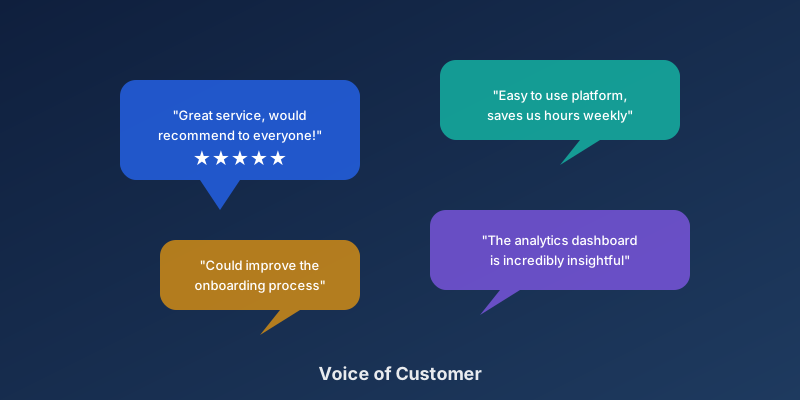
VoC is not a survey programme. Instead, it is a system for continuously understanding what customers need, what frustrates them, and what drives them to stay. Here is how to build one that works.