
Voice of Customer (VoC): The Complete B2B Guide [2026]
Most VoC programmes do not die from bad technology. They die from the action nobody owns. Here is how to build one that connects feedback to account value and revenue, not just a dashboard.
![Voice of Customer (VoC): The Complete B2B Guide [2026]](/img/knowledge/voc.svg)
- Voice of Customer means collecting feedback from every account and every touchpoint, then routing it to a named owner with a deadline. Collection alone is not a programme.
- Effective VoC combines quantitative data (NPS, CSAT, CES) with qualitative data (interviews, open-ended responses, support tickets). Neither is sufficient alone.
- 62% of B2B companies never connect their VoC data to revenue, and 44% cannot state their own churn rate (CustomerGauge). The failure point is almost never the survey.
- In B2B, feedback has to be weighted by account value. Treating a small account the same as your largest one is the most common design mistake we see.
- Start simple: 2-3 channels, one specific business problem. The perfect VoC programme does not exist. The one you actually run beats the one you plan forever.
Contents9 sections
VoC Is Not a Survey
Most companies think Voice of Customer means sending NPS surveys. However, that is a fraction of it. VoC is the entire system for collecting, analysing, and acting on what your customers think, need, and experience, through every channel where they express it.
Customers tell you what they think in surveys. They also tell you through support tickets, review sites, sales conversations, product usage patterns, and social media. Consequently, a VoC programme that only captures survey data misses most of the signal. The survey is still the load-bearing part, though, because it is the only channel that gives you a comparable number: how to measure customer satisfaction covers how to get that part right before you build the wider listening system around it.
The B2B version of VoC is structurally different from B2C, and not just because the accounts are bigger. Accenture found that only 28% of B2B leaders feel they have real influence over their own customer experience, and the reason is usually organisational, not technical. A handful of named account managers hold the relationship, a handful of accounts hold most of the revenue, and multiple stakeholders inside each account rarely agree on how the relationship is actually going. One survey score per account tells you almost nothing about whether that account is at risk.
Why Do Most VoC Programmes Never Get Past Data Collection?
Here is the uncomfortable part. Sprinklr's 2026 maturity benchmarks describe an eight-dimension model running from reactive feedback collection to predictive, financially linked customer intelligence, and very few enterprises ever reach the top level. That is not because collecting feedback is hard. Collection is the easy 20%.
The real failure point sits between insight and action. CustomerGauge research puts a number on it: 62% of B2B companies never connect their VoC data to revenue at all, and 44% cannot even state their own churn rate. Somewhere between the dashboard and the account manager's desk, the feedback just stops moving.
Here is the contrarian part: more feedback usually makes this worse, not better. A team that starts collecting from every channel, every account, every week, without first deciding who owns the action queue, ends up with a bigger backlog and the same unhappy customer unaddressed a month later. Maturity is not a data problem. It is an ownership problem. If you have never mapped where your organisation sits on that ladder, our CX maturity model is a faster starting point than another feedback channel.
The Four Components of an Effective Programme
1. Collection channels
- Support tickets and chat transcripts
- Online reviews (Google, G2, Trustpilot)
- Social media mentions
- Sales call notes and CRM comments
- Product usage data and feature adoption
- Website analytics (heatmaps, funnel drop-off)
- Churn patterns and renewal behaviour
The best programmes combine all three types. Specifically, survey data tells you what customers think. Support data tells you what frustrates them. Behavioural data tells you what they actually do.
| Data channel | What it captures | Best used for |
|---|---|---|
| Direct feedback (NPS, CSAT, interviews) | Explicit sentiment and stated reasons | Tracking trends over time, comparing accounts |
| Indirect feedback (support tickets, reviews, social) | Unprompted friction or praise | Catching issues from accounts that never answer a survey |
| Behavioural signals (usage, logins, meeting attendance) | What accounts actually do, not what they say | Flagging churn risk before any survey score drops |
Most B2B teams over-invest in the first row and under-invest in the third. The accounts that never respond to a survey are frequently your highest churn risk, not your safest ones.
2. Analysis
Raw data is not insight. Therefore, VoC analysis includes:
- Quantitative analysis: NPS trends, CSAT benchmarks by segment, response rate tracking
- Qualitative analysis: Theme identification from open-ended responses, categorisation of complaints and praise. At B2B volume this is where AI text analytics earns its keep, if the tagging feeds routing rather than just a dashboard
- Predictive analysis: Which signals predict churn? Which predict expansion? Where is the strongest correlation between satisfaction and revenue?
3. Action framework
Indeed, data without action is the most common VoC failure. A working action framework specifies:
- Who owns the response to each type of feedback?
- What is the SLA for acting on critical feedback?
- How are systemic improvements prioritised?
- How are changes communicated back to customers?
The inner loop handles individual customer issues within 48 hours. The outer loop aggregates patterns monthly and drives structural improvements.
4. Governance and reporting
VoC data must reach decision-makers at the right cadence:
- Monthly CX dashboards for leadership (NPS trend, top complaint themes, close-the-loop metrics)
- Quarterly VoC reviews with the C-suite (strategic themes, ROI, programme effectiveness)
- Ongoing tactical updates for operational teams (support trends, product feedback, onboarding friction)
If you run VoC across multiple business units, brands or countries, the governance model looks slightly different: some things have to be defined centrally to stay comparable, others have to stay local to stay correct. See Voice of Customer across business units for where that line belongs.
Building Your Programme: Step by Step
Step 1: Start with a specific business problem
Not "improve customer experience." That is too vague to drive action. Instead, pick a measurable problem:
- "Reduce annual churn from 12% to 8%"
- "Identify the top three friction points in onboarding"
- "Understand why mid-market accounts score 25 points lower on NPS than enterprise"
Step 2: Map the customer journey
Identify the touchpoints that matter most for your business problem. Use customer journey mapping to see the experience from the customer's perspective. Prioritise the three to five touchpoints with the biggest impact on the outcome you are trying to change.
Step 3: Choose 2-3 channels
Do not try to capture everything from day one. Rather, a strong starting combination for B2B:
- Quarterly relational NPS to the full customer base
- Transactional CSAT at key touchpoints (support, onboarding)
- Monthly calls with 5-10 customers from different segments
In a B2B portfolio where a few accounts carry most of the revenue, design this around accounts rather than respondents. Account-based CX covers weighting feedback by account value and surveying the whole buying group instead of one contact.
Step 4: Automate collection and tracking
Set up triggered surveys, dashboard tracking, and CRM integration so data flows automatically. After all, manual processes create delays, inconsistency, and missed feedback.
Step 5: Establish analysis routines
Define who analyses, when, and what they look for. A weekly scan of incoming feedback, a monthly theme analysis, and a quarterly deep dive is a solid cadence. Standardise the categorisation so trends are trackable.
Step 6: Build action workflows
- Inner loop: Individual follow-up on negative feedback within 48 hours. Clear ownership and SLA. See Close the Loop.
- Outer loop: Monthly root cause analysis. Top themes assigned to functional owners with timelines and success metrics.
Step 7: Tell customers what changed
"You said, we did." Communicate changes that resulted from feedback. Customers who see that their input drove action are 3x more likely to respond to future surveys (Qualtrics XM Institute). This is not optional, it is what makes the programme self-sustaining.
What We See Go Wrong
Five mistakes that kill VoC programmes:
1. Collection without action. The most common failure. 75% of B2B companies collect feedback (CustomerGauge). Fewer than 30% act on it systematically. Customers who give feedback and see nothing change become more dissatisfied than those who were never asked.
2. Survey overload. Long surveys, too-frequent surveys, uncoordinated surveys from multiple departments. The result is fatigue, declining response rates, and biased data. See How to Improve Response Rates.
3. No executive sponsor. VoC requires changes across product, support, sales, and operations. Without C-level sponsorship, the programme lacks the authority to drive those changes.
4. Siloed data. Marketing owns survey data. Support owns ticket data. Sales owns call notes. Nobody has the full picture. The most valuable VoC insights come from combining data across channels and departments.
5. Waiting for perfection. The programme will never be perfect. The companies that get value from VoC are the ones that start simple and iterate, not the ones that spend 18 months designing the ideal system.
6. Ignoring the compliance side of verbatims. Open-text answers accumulate personal data by default, and few teams own their deletion. Before you scale up, agree the legal basis and retention rule for the whole programme, not each survey.
How Do You Collect VoC Data Without Breaking GDPR?
You do not need explicit consent to run a satisfaction survey, but you do need the right legal basis, disciplined data minimisation, and feedback data you can actually export on request. This matters more in 2026 than it did a year ago, because the EU Data Act adds portability obligations on top of GDPR's existing rules. We cover the legal basis, retention periods and export requirements in detail in GDPR and customer feedback in B2B. Read it before you add a new data channel to your VoC programme, not after.
Is Your VoC Programme Mature Enough to Trust?
Sprinklr's benchmarks put closed-loop coverage at 80-90% of actionable feedback for a genuinely mature programme, rising to 85-95% at the top level, with automated triggers replacing manual follow-up. If your own number is closer to "we get to the angriest ones eventually," you are not at that level yet, and no amount of extra survey volume will get you there. What will: a defined owner per theme, a time-to-action SLA, and the financial linkage described above.
How Nordika A/S Uses VoC to Protect Its Highest-Value Accounts
Picture a mid-market logistics provider like Nordika A/S, with 140 active B2B accounts and a familiar problem: the same survey going to every contact, regardless of whether that account represents 2,000 or 200,000 euros a year. After weighting feedback by account value and surveying the full buying group at its top 30 accounts, Nordika's CX team found that three of its five largest customers had detractor scores that a single-contact NPS survey had never surfaced. Closing the loop on those three, with a named owner and a 48-hour response deadline, is the kind of action a mature VoC programme is built to trigger. This is where SurveyGauge's platform and advisory work together: the platform surfaces which accounts need attention now, and the advisory side helps build the governance model that keeps it working after the first quarter.
Measuring Programme Effectiveness
Track these metrics to know whether your VoC programme is working:
| Metric | What it tells you |
|---|---|
| NPS trend | Is overall loyalty improving? |
| Response rate | Is the programme reaching enough customers? |
| Close-the-loop rate | Are you acting on feedback? |
| Time-to-action | How fast are you responding to critical feedback? |
| Churn rate by NPS segment | Is the programme preventing churn? |
| Revenue correlation | Does satisfaction predict retention and expansion? |
Ultimately, the measure that matters most is commercial impact: lower churn, higher expansion revenue, more referrals. Everything else is a leading indicator.
Start with one problem. Two or three channels. A clear action framework. And the discipline to follow through. That is all you need. The sophistication comes later, one step at a time up the CX maturity model.
Frequently Asked Questions
Ready to know what your customers actually think?
SurveyGauge helps Nordic B2B companies move from gut feeling to data-driven CX decisions.
SurveyGauge Team
Customer Experience Experts
SurveyGauge-teamet hjælper virksomheder med at måle og forbedre kundetilfredshed via professionelle surveys, analyser og rådgivning.
You might also be interested in
View all articles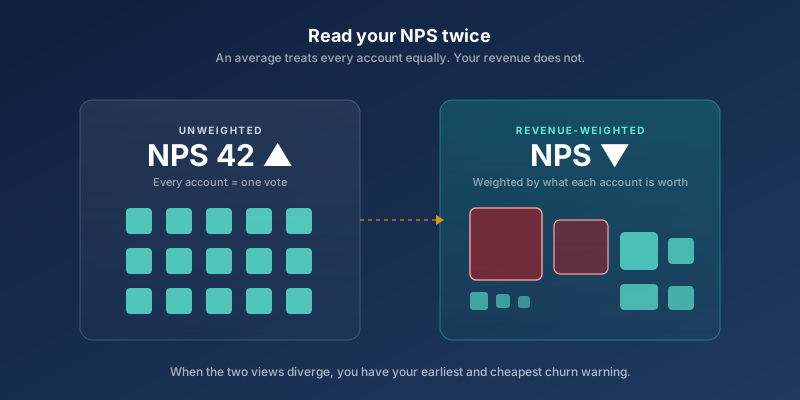
Account-Based CX: Run Your Feedback Programme on the Accounts That Pay the Bills
In most B2B companies a small share of accounts carries most of the revenue, yet every account gets the same survey and the same weight in the score. Account-based CX fixes that mismatch: weight feedback by account value, survey the whole buying group, and tier your follow-up.
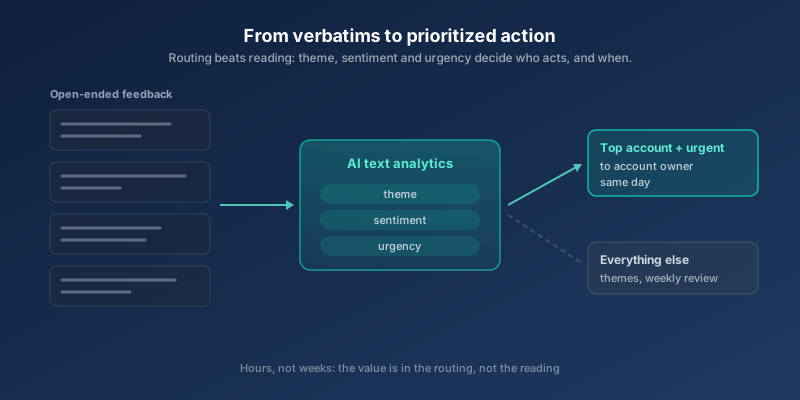
AI Text Analytics for Customer Feedback: From Verbatims to Prioritized Action
Most B2B teams buy AI text analytics to save analyst hours. The real return comes from something different: routing high-value, high-urgency feedback to the right owner in hours, not weeks.
![GDPR and Customer Feedback in B2B: What You Can Actually Collect [2026]](/img/knowledge/gdpr-customer-feedback.svg)
GDPR and Customer Feedback in B2B: What You Can Actually Collect [2026]
You do not need consent to run a satisfaction survey. You need the right legal basis, disciplined data minimisation, and feedback data you can actually export. A 2024 CJEU ruling now shapes how you document that basis, and the EU Data Act's switching-fee ban has an exact date.
![What Is NPS? The Complete Guide to Net Promoter Score [2026]](/img/knowledge/nps.svg)
What Is NPS? The Complete Guide to Net Promoter Score [2026]
NPS is the most widely used loyalty metric in the world, and also the most frequently misused. Indeed, the score means nothing without follow-up. Here is how to use it properly.
10 Rules for Surveys That Deliver Real Insights
A poorly designed survey is worse than no survey. It gives you confidence in data that is wrong. Here are ten rules that fix the most common mistakes we see in B2B survey programmes.