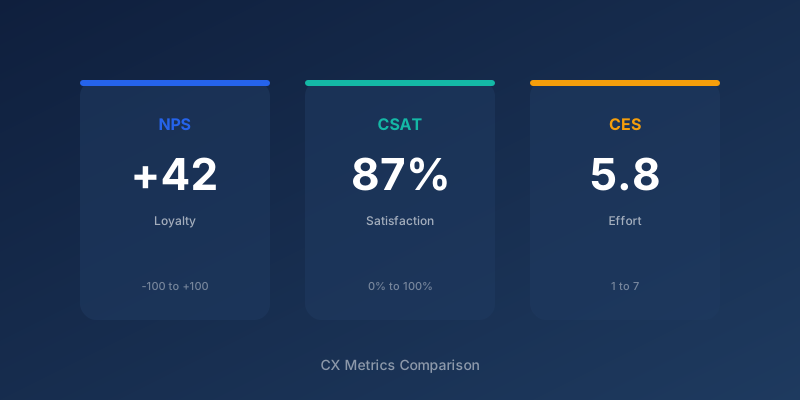
What Is CES? Customer Effort Score Explained
Most CX programmes chase delight. However, the research says the opposite works better: remove friction. CES measures exactly that, and it predicts churn more reliably than satisfaction ever will.
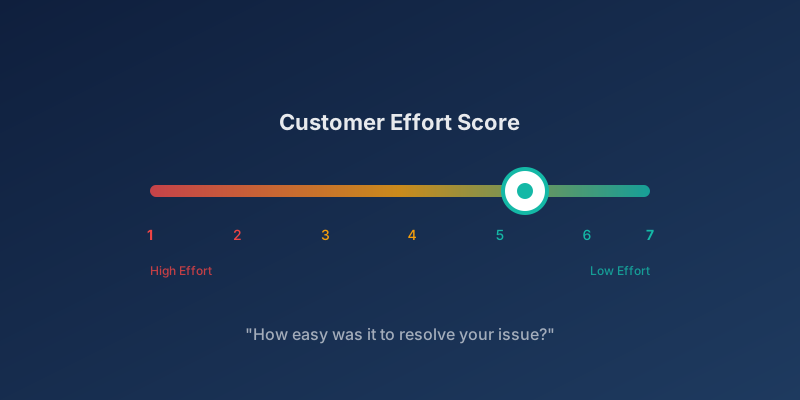
- CES measures effort, not happiness. That distinction matters because effort predicts churn far better than satisfaction does.
- Gartner's research is blunt: 96% of customers with high-effort experiences become disloyal. Delight is irrelevant if the basics are hard.
- Use CES at transactional touchpoints like support, checkout, and onboarding. It is not a relationship metric.
- In particular, among the B2B companies we work with, the ones tracking CES alongside NPS consistently find friction problems. These are issues that CSAT alone misses.
Most CX programmes are built around a flawed assumption: that delighting customers is what keeps them. However, the research says otherwise. What actually drives loyalty is not exceeding expectations. Instead, it is removing the barriers that make normal interactions unnecessarily hard.
That is what Customer Effort Score measures. Not happiness. Not loyalty. Effort.
Where CES Came From, and Why It Matters
Matthew Dixon and his colleagues at CEB (now Gartner) published "Stop Trying to Delight Your Customers" in Harvard Business Review in 2010. The findings were uncomfortable for every company investing in "wow moments":
- 96% of customers with a high-effort service experience became more disloyal
- 88% of high-effort customers spread negative word of mouth
- Reducing effort was a stronger driver of loyalty than trying to exceed expectations
The implication is stark. Therefore, your priority should not be making things wonderful. It should be making things easy. Delight is a bonus. Ease is the foundation.
The CES Question
The standard CES question is a statement, not a question:
"The company made it easy for me to handle my issue."
Customers respond on a 7-point scale:
- 1 = Strongly disagree (high effort, bad)
- 7 = Strongly agree (low effort, good)
Common variants include "How easy was it to resolve your issue today?" with a difficulty scale. Either works, but pick one and stick with it. After all, changing the wording breaks your trend data.
Scale: 1-7 Low effort (good): Score 5-7 High effort (risk): Score 1-3 Measures: Friction and customer effort Best for: Support, checkout, onboarding, complaints Typical frequency: Immediately after interaction
Calculating CES
Straightforward:
CES = Average score of all responses
Five customers score 6, 7, 5, 4, and 6:
CES = (6 + 7 + 5 + 4 + 6) / 5 = 5.6
You can also segment responses into low effort (5-7), neutral (4), and high effort (1-3) to see the distribution. In fact, the distribution often tells you more than the average. A mean of 5.4 with 20% scoring 1-3 is a different situation than a mean of 5.4 with 5% in the danger zone.
Where CES Belongs (and Where It Does Not)
CES is a transactional metric. It measures friction at specific touchpoints. It is not a substitute for NPS as a relationship metric and it does not measure emotional satisfaction the way CSAT does.
Where CES works best
Customer support. This is CES territory. After every support interaction, whether chat, email, phone, or self-service, measure how hard it was to get help.
Checkout and payment flows. Cart abandonment is overwhelmingly caused by friction, not indecision. CES pinpoints whether your checkout is the problem.
Onboarding. Customers who struggle in the first weeks are at severe risk of quietly churning at renewal. CES tells you if onboarding is too complex before the customer tells you by leaving.
Returns and complaints. These are already negative experiences. Making them hard as well is a guaranteed path to losing the customer. CES here can preserve relationships that would otherwise end.
Self-service portals. If your knowledge base is supposed to reduce support load, CES tells you whether it actually does.
Where CES does not work
Do not use CES to measure overall brand perception, emotional connection, or long-term loyalty. Those are NPS and CSAT territory. CES is surgical, not strategic.
CES vs. CSAT vs. NPS
| Question | Best Metric |
|---|---|
| Will this customer recommend us? | NPS |
| Was this specific experience satisfactory? | CSAT |
| Was this process easy? | CES |
| Is this customer likely to churn? | CES |
| Which touchpoints need work? | CSAT + CES |
For the full comparison: NPS vs. CSAT vs. CES.
CES Benchmarks by Industry
CES benchmarks are less established than NPS benchmarks because the metric is younger and calculation methods vary. These figures are indicative on a 7-point scale:
| Industry | Typical CES Average |
|---|---|
| SaaS / Tech Support | 5.0-5.8 |
| E-commerce / Returns | 4.8-5.5 |
| Financial Services | 5.2-5.7 |
| Telecommunications | 4.5-5.2 |
| Healthcare | 5.0-5.5 |
Above 5.5 is solid. Below 4.5 is a clear signal that friction is actively driving customers away.
What We See in Practice
Among the B2B companies we work with, a few patterns recur:
CES reveals problems that CSAT hides. A customer can report being "satisfied" with a support interaction that took three transfers and two days. The outcome was fine, but the effort was high. CSAT scores 4 out of 5. CES scores 2 out of 7. The CSAT score suggests everything is working. The CES score shows the process is broken.
Moreover, onboarding CES is the strongest early-churn predictor. Companies that measure CES at day 7 and day 30 of onboarding can intervene before the customer mentally disengages. By the time you send a quarterly NPS survey, a struggling customer has already decided to leave.
Self-service CES is consistently underused. Most companies build a knowledge base and assume it works. Measuring CES on self-service usage reveals whether customers actually find what they need, or whether they give up and call support anyway.
Common Mistakes with CES
Treating CES as a relationship metric. CES is transactional. Sending a CES survey once a quarter to your whole customer base makes no sense. Trigger it after specific interactions.
Only looking at the average. A CES of 5.2 sounds acceptable. Yet if 25% of respondents scored 1-3, you have a serious friction problem with a specific subset of customers. Always look at the distribution.
Not asking the follow-up question. A CES score tells you effort was high. It does not tell you why. Always include one open-ended question: "What could we have done to make this easier?"
Measuring without ownership. If nobody owns the CES score for a specific process, nobody improves it. Assign process owners before you start measuring.
Five Ways to Reduce Customer Effort
- Invest in self-service. Most customers prefer to solve problems themselves. A well-structured knowledge base, clear documentation, and an effective search function reduce effort for the customer and load for your support team.
- Remove unnecessary steps. Walk through your most important customer-facing processes and ask: can we remove a step here? Can we pre-fill this form? Can we eliminate this approval? Every extra step is effort, and effort drives churn.
- Reduce support handoffs. Being transferred from agent to agent is one of the highest-effort experiences a customer can have. Track first-contact resolution as a KPI and give agents the authority and tools to resolve issues without escalation.
- Communicate proactively. Shipping updates, status notifications, known-issue alerts. Every proactive message is a support ticket that never gets created. That is effort removed before the customer even notices.
- Optimise for mobile. A large and growing proportion of customer interactions happen on phones. If your flows are clunky on mobile, you are generating effort for the majority of your users. Test every critical process on mobile devices.
CES and Churn
This is the core argument for CES. Gartner's research found that:
- Customers with low-effort experiences had a 94% likelihood of repurchasing
- Low-effort customers were 88% likely to increase their spending
- High-effort customers were 4 times more likely to become disloyal than merely dissatisfied customers
Satisfaction does not retain customers. Ease does. Consequently, if you are serious about reducing churn, CES should be part of your measurement stack. Pair it with NPS for the strategic view and CSAT for touchpoint detail, and you have a complete picture.
For more on building a churn reduction strategy: How to Reduce Churn.
Frequently Asked Questions
The standard is a 7-point Likert scale. The statement is: 'The company made it easy for me to handle my issue.' A score of 7 means zero friction. Some teams flip the scale or use 5 points, but consistency matters more than which variant you pick. Just stick with one.
When you care about predicting future behaviour, not just measuring past satisfaction. CSAT tells you a customer was happy right now. CES tells you whether they will stay. Indeed, in our experience, CES catches process problems that CSAT scores gloss over. Customers can be 'satisfied' with a painful process if the outcome was acceptable.
No, and you should not try. CES is a transactional metric tied to specific interactions. Instead, if you want a relationship-level view, use NPS. CES shines at pinpointing where friction lives in specific processes like support, checkout, and onboarding.
On a 7-point scale, an average above 5.5 is solid. But the average can hide problems. What you really need to watch is the proportion of low scores (1-3). Those customers are the ones most likely to leave. A mean of 5.8 with 15% scoring 1-3 is actually worse. A mean of 5.5 with only 5% in the danger zone is healthier.
Remove steps. Every extra click, every handoff between departments, every form field that is not strictly necessary adds effort. The most impactful moves: investing in self-service documentation, reducing support transfers, simplifying onboarding flows, and killing unnecessary approval steps in processes.
Ready to know what your customers actually think?
SurveyGauge helps Nordic B2B companies move from gut feeling to data-driven CX decisions.
SurveyGauge Team
Customer Experience Experts
SurveyGauge-teamet hjælper virksomheder med at måle og forbedre kundetilfredshed via professionelle surveys, analyser og rådgivning.
You might also be interested in
View all articles![What Is NPS? The Complete Guide to Net Promoter Score [2026]](/img/knowledge/nps.svg)
What Is NPS? The Complete Guide to Net Promoter Score [2026]
NPS is the most widely used loyalty metric in the world, and also the most frequently misused. Indeed, the score means nothing without follow-up. Here is how to use it properly.

What Is CSAT? Guide to Customer Satisfaction Score
CSAT is the most direct satisfaction metric you can use, but it is also the most abused. Therefore, here is how to deploy it properly, when to trust it, and when it misleads.