
Personalization Drives 20% of Customer Loyalty: What It Means for Your CX Strategy
Personalization drives the single largest share of customer loyalty in KPMG's global CX benchmark. But Gartner's 2025 data shows it backfires for over half of customers when it feels like surveillance rather than help. Here is how to get it right in B2B.
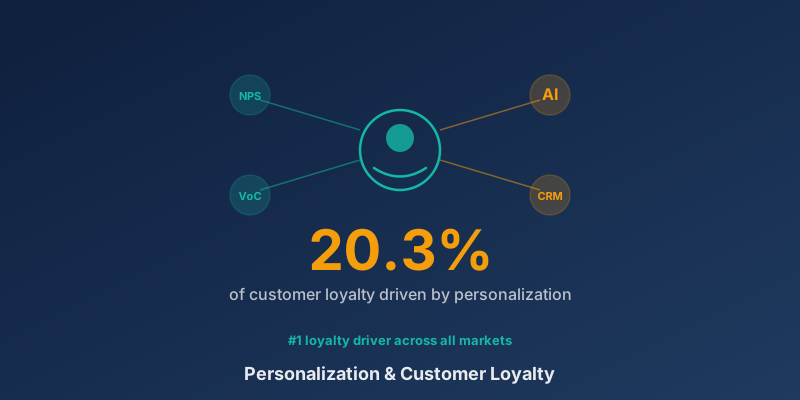
- Personalization drives 20.3% of customer loyalty according to KPMG's Global Customer Experience Excellence 2025-2026 report, more than any other pillar.
- B2B buying groups now average 13 internal stakeholders and nine external influencers (Forrester, State of Business Buying 2026), and personalization has to hold up across all of them.
- Contrarian finding: Gartner's 2025 research shows personalization backfires for 53% of customers, making them 3.2x more likely to regret the purchase, when it feels like surveillance instead of help.
- AI makes personalization scalable, but only the genuine kind, built on consent, context and a visible benefit, survives that test. Superficial personalization erodes the trust it was supposed to build.
Contents8 sections
According to KPMG's Global Customer Experience Excellence 2025-2026 report, personalization is the single strongest driver of customer loyalty. At 20.3%, it outweighs Integrity (18.2%), Time & Effort (16.9%) and Expectations (16.3%).
What the 2025 research adds to that picture is a warning. Done badly, personalization actively costs you the loyalty it was supposed to buy. This article covers both halves.
What Personalization Is Not
Let's start with what personalization is not:
- Using the customer's name in an email subject line
- Sending the same campaign to everyone with a "Dear [First Name]"
- Recommending products based solely on historical purchases
- Segmenting customers into broad groups and treating them identically within each group
These are table stakes in 2026. In other words, they are not personalization, they are automation.
What Genuine Personalization Requires
KPMG's report defines personalization as: demonstrating understanding of the customer's specific circumstances and adapting the experience accordingly.
In practice, this requires three things:
- Genuine personalization
- Unified customer viewData flowing across front, middle and back office
- AI-powered analysis at scaleTopic, sentiment and preference, per customer
- Proactive actionInsight turned into behaviour at the point of contact
1. A Unified Customer View
Personalization requires data flowing across front, middle, and back office. If sales, support, and success each have their own customer picture, genuine personalization is impossible.
2. AI-Powered Analysis at Scale
No one can manually analyse feedback from thousands of customers and identify individual patterns. AI makes it possible to classify open-ended responses by topic and sentiment, identify individual preferences and concerns, predict needs based on behavioural patterns, and prioritise effort based on business value.
The catch is that scale alone does not produce returns. As we cover in AI and customer experience in 2026, the organisations that actually realise value from AI are the ones where an executive owns what the AI decides on the customer's behalf, not the ones with the largest model budget.
3. Proactive Action
Personalization is not just about understanding, it is about acting on that understanding. It requires processes that turn insight into concrete behaviour at the point of customer interaction.
Personalization in B2B: 13 Internal Stakeholders, Nine External Influencers
The average B2B purchase now involves 13 internal stakeholders and nine external influencers, and that number keeps rising, according to Forrester's State of Business Buying, 2026. For purchases that include generative AI features, the buying group roughly doubles again: 14 members against seven for purchases without them. As we break down in the six pillars of customer experience, the number scales with deal value and complexity rather than being fixed. Either way, it creates unique personalization demands:
- Different roles, different needs: the CFO, the IT director, and the end user have vastly different priorities. Personalization must address them all, not just the one person who filled out the demo request form.
- Account-level, not individual-level: in B2B, personalization is often most valuable at the account level. This is the logic behind account-based CX: weight your feedback programme and your follow-up by account value, and adapt communication to that account's stated priorities, not to any single contact's preferences.
- Long-term relationships: B2B relationships span years. Personalization is about building cumulative understanding over time, not one-shot campaigns.
The Personalization Paradox: When It Backfires
Here is the point most personalization guides skip. Gartner's 2025 research into 1,464 B2B buyers and consumers found that personalized marketing produces negative experiences for 53% of customers, who become 3.2 times more likely to regret the purchase and 44% less likely to buy again. Customers who went through a personalized journey were also 2.8 times more likely to feel time pressure and twice as likely to feel overwhelmed by the volume of information sent their way.
That is not an argument against personalization. It is an argument against the superficial kind this article opened by ruling out. The "creepy line" Gartner describes sits exactly where personalization stops demonstrating understanding and starts demonstrating surveillance, the same distinction KPMG draws between genuine and superficial personalization. A vendor that references a customer's stated roadmap priorities in a renewal conversation is personalizing. A vendor that references browsing behaviour the customer never knowingly shared is not, even if the underlying technology is identical.
The practical fix is not less personalization, it is transparency about what data drives it and a visible benefit in return. Buyers who experienced what Gartner calls course-changing personalization, meaning real guidance at a decision point rather than a name in a subject line, were 2.3 times more likely to complete the purchase with confidence. The difference between the two outcomes is not the AI model. It is whether the customer can tell why you know what you know.
Personalization as Competitive Advantage
KPMG notes that organizations investing in personalization consistently outperform their competitors. CX leaders score significantly higher on the Personalization pillar than the rest of the market. Banking, the fourth-best sector globally in KPMG's benchmark, wins partly because the sector adopted AI for hyper-personalization early. Retail, the best sector on Time & Effort, shows that personalization and friction reduction reinforce each other.
- Personalization20.3%
- Integrity18.2%
- Time & Effort16.9%
- Expectations16.3%
From Personalization to Anticipatory CX
The report's most forward-looking point is the shift from reactive to anticipatory personalization. It is no longer about responding personally to an inquiry, but about predicting needs and acting before the customer has to ask.
Examples:
- Identifying a customer showing signs of dissatisfaction before they become a detractor, the same early-warning logic behind a customer health score
- Offering proactive guidance based on the customer's usage patterns
- Recommending actions based on what similar customers have succeeded with
This requires three things: clean data, intelligent analysis, and expertise to act, and the same discipline that keeps personalization from crossing the creepy line described above.
How to Build Personalized CX in Practice
Step 1: Establish Systematic Feedback Collection
You cannot personalize what you do not measure. Start with NPS, CSAT, and open-ended questions that give you qualitative insight into what each customer experiences.
Step 2: Build an Integrated Customer View, on a Minimal Data Footprint
Connect feedback data with CRM, support, and sales data. This creates a 360-degree picture of each customer, but more data is not automatically better data. As we cover in GDPR and customer feedback in B2B, collecting only what you have a clear purpose for is not just a compliance requirement. It is also what keeps personalization on the right side of the creepy line: customers tolerate data use they understand and distrust data use they cannot explain to themselves.
Step 3: Use AI to Identify Patterns
AI-powered sentiment analysis and topic classification make it possible to identify preferences, concerns, and trends at individual and segment levels.
Step 4: Automate the Operational, Personalize the Strategic
Automate routine follow-up (close the loop, thank-you emails, alerts). Invest the freed-up time in personalized, strategic interactions.
Step 5: Measure and Iterate
Personalization is not a one-time implementation. Measure the impact continuously, and adapt your approach based on data, including whether customers experience it as help or as surveillance.
How SurveyGauge Helps
SurveyGauge delivers the foundation for personalized CX:
- Platform: AI-powered analysis that identifies individual customer patterns, and CRM integrations that create a unified customer view
- Administration: we handle the operational work, so your team can focus on personalized action
- Advisory: our CX experts help you turn data into personalized strategies without crossing into the territory customers experience as surveillance
Source: KPMG Global Customer Experience Excellence 2025-2026, "Total Experience: Redefining excellence in the age of agentic AI"; Forrester, The State of Business Buying, 2026; Gartner, 2025 survey on personalization and customer regret (published June 2025).
Frequently Asked Questions
Ready to know what your customers actually think?
SurveyGauge helps Nordic B2B companies move from gut feeling to data-driven CX decisions.
SurveyGauge Team
Customer Experience Experts
SurveyGauge-teamet hjælper virksomheder med at måle og forbedre kundetilfredshed via professionelle surveys, analyser og rådgivning.
You might also be interested in
View all articles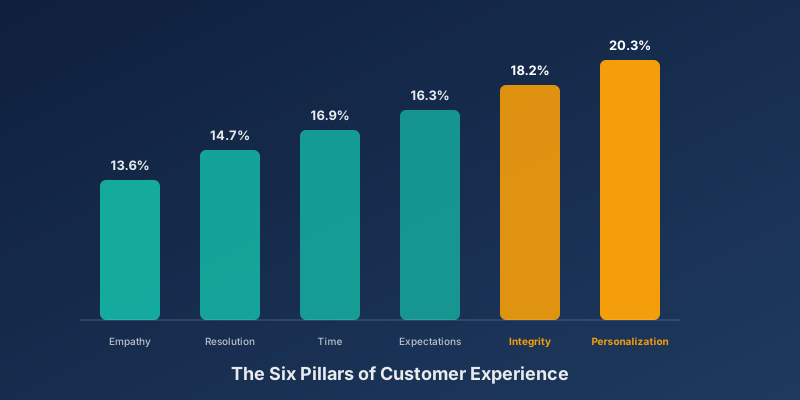
The 6 Pillars of Customer Experience: What Drives Loyalty and NPS
KPMG's Customer Experience Excellence report identifies six universal drivers behind NPS and loyalty, weighted from 80,594 interviews. Integrity and Personalization combined drive 39% of loyalty, and B2B buying committees make Personalization structurally harder than in B2C.
AI and Customer Experience in 2026: From Agentic AI to Anticipatory CX
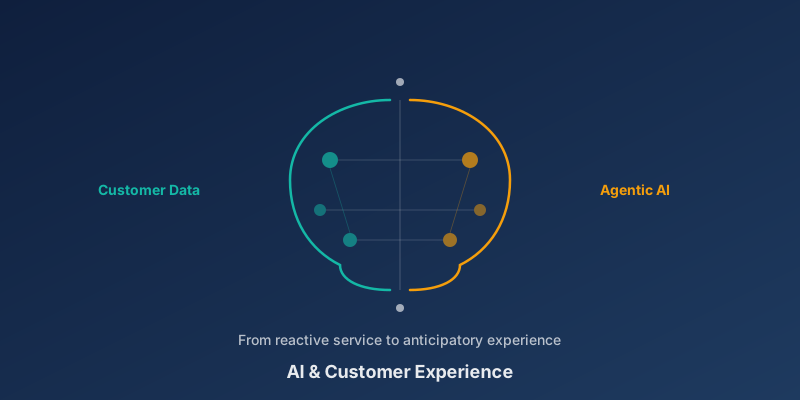
KPMG's global CX benchmark shows 55% of CEOs rank AI as their top investment priority. A newer KPMG pulse survey shows the real divide isn't model quality, it's whether the CEO is actually accountable for AI-driven decisions.
Account-Based CX: Run Your Feedback Programme on the Accounts That Pay the Bills
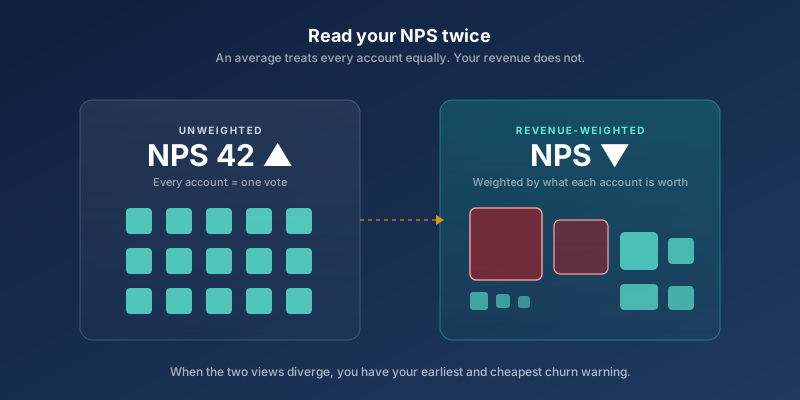
In most B2B companies a small share of accounts carries most of the revenue, yet every account gets the same survey and the same weight in the score. Account-based CX fixes that mismatch: weight feedback by account value, survey the whole buying group, and tier your follow-up.
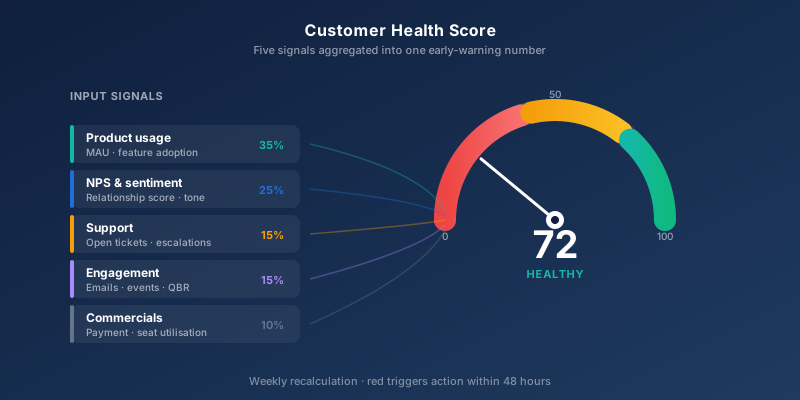
Customer Health Score: Build an Early Warning System for Churn
Customers decide to churn 60-90 days before the cancellation hits your CRM. A Customer Health Score surfaces the signal before you lose them. Here is how to build one that actually works.
![Voice of Customer (VoC): The Complete B2B Guide [2026]](/img/knowledge/voc.svg)
Voice of Customer (VoC): The Complete B2B Guide [2026]
Most VoC programmes do not die from bad technology. They die from the action nobody owns. Here is how to build one that connects feedback to account value and revenue, not just a dashboard.