
Getting Started with NPS: A 5-Step Implementation Guide
NPS only delivers value when it is implemented as a system, not just a metric. Therefore, here are the five steps we recommend, based on what we see working in practice.
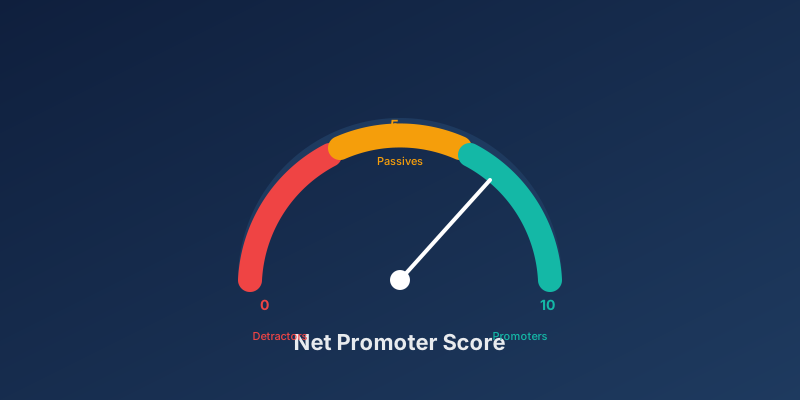
- Without a clear purpose, NPS becomes a number in a dashboard nobody acts on
- Transactional and relational NPS answer different questions, choose the right one for your situation
- Importantly, reporting must be designed for action, not for information
- Close the loop is what separates organisations that drive change from those that merely measure
Most NPS implementations fail for the same reason
The organisation buys a survey tool, sends an NPS survey, gets a number, and puts it in a dashboard. Inevitably, six months later, response rates have dropped, nobody acts on the data, and leadership asks what they are actually paying for.
However, the problem is not NPS. It is the implementation. NPS is a system, not a metric. And like any system, it requires a clear purpose, the right processes, and a plan for what happens with the data.
Here are the five steps we recommend, based on what we see working in practice.
Step 1: Define your purpose, not your metric
Before you send a single survey, you need to be able to answer: Why do we want to measure NPS?
The most common purposes are:
- Reduce churn: Identify Detractors early and reach them before they cancel
- Grow through referrals: Understand what drives Promoters and replicate it
- Identify process gaps: Discover which touchpoints create friction
- Benchmark performance: Compare against industry averages and internal periods
In short, the purpose determines everything else. What you measure, when you measure it, who sees the data, and what happens with it.
A clear purpose is action-oriented: "We are implementing NPS to reduce churn by contacting Detractors within 48 hours." That is a purpose you can design a system around. "We want to know what customers think" is not.
What typically goes wrong: The purpose is too vague, or it is missing entirely. The result is that the survey goes out, data comes in, but nobody knows what to do with it. Write a one-page business case: current churn challenge, expected impact of the NPS programme, success criteria for the first six months.
Step 2: Choose the right timing
There are two primary NPS models. The choice depends on your purpose.
Transactional NPS is sent automatically after a specific customer interaction: a purchase, a support ticket resolution, an onboarding session. Timing is typically 24-48 hours after the event. As a result, it yields high response rates and concrete, actionable insights about specific processes.
Relational NPS is sent at fixed intervals, quarterly or biannually, to all customers or segments. It measures the overall experience of the relationship. It gives you a strategic overview, trend tracking, and benchmarking capability.
Our recommendation: Start with one model. The most mature programmes use both, but if you try to run both from day one, both end up half-baked. Instead, build one, get it working, then add the other.
Timing advice from practice:
- Avoid Friday afternoon and Monday morning sends. Open rates are lowest
- For B2C: SMS delivers 2-3x higher response rates than email for transactional NPS
- For B2B: Email with a personal sender (CSM or account manager) significantly outperforms generic senders
What typically goes wrong: The organisation sends relational NPS monthly "to get more data points." The result is survey fatigue, declining response rates, and data that is difficult to interpret because the time horizon is too short.
Step 3: Set up the survey and keep it simple
An NPS survey does not need to be complex. Indeed, the more you add, the lower your response rate.
Question 1 (required): "How likely are you to recommend [Company] to a colleague?" (0-10)
Question 2 (strongly recommended): "What is the most important reason for your score?" (Open text field)
Question 3 (optional): A segment-specific follow-up. Detractors: "What could we have done better?" Promoters: "What are you most satisfied with?"
- Keep the survey under three minutes to complete
- Always optimise for mobile. Over 60% of NPS responses are submitted on mobile
- Use neutral, non-leading wording
- Every additional question reduces response rate. Be disciplined
Personalisation elements that work:
- Customer's name in the subject line
- Reference to the specific interaction ("We hope your visit to our store on 15 January...")
- Personal sender (not "no-reply@...")
In practice, we see personalisation alone lift response rates by 5-10%. Thus, a small investment with a large return.
What typically goes wrong: Marketing wants to add "just two more questions." The product team wants one too. Suddenly it is a 15-question survey and the response rate halves. Be uncompromising about short surveys.
Step 4: Design reporting for action, not information
The key question for every reporting element: Who is supposed to act on this, and what should they do?
Operational level (daily/weekly):
- Real-time feed of new Detractor scores with reasons
- Weekly briefing to team leaders with NPS trend and new feedback
- This is your early warning system. Keep it simple and fast
Tactical level (monthly):
- NPS trend over time, segmented (channel, product, region)
- Most frequently mentioned themes in open-ended responses (categorised)
- Close-the-loop metrics: how many Detractors were contacted? How many were "saved"?
Strategic level (quarterly):
- NPS vs. benchmark
- Correlation between NPS and business KPIs (churn, repurchase rate, LTV)
- Quarterly trend analysis and recommended priorities
What typically goes wrong: The organisation drowns in data. Consequently, everyone gets everything, and nobody knows what is relevant to them. Identify three to five key metrics per level. Everything else is available for those who want to dig deeper, but the briefing must be sharp and actionable.
Step 5: Close the loop, the decisive step
Ultimately, close the loop is what separates organisations that transform the customer experience from those that merely measure it. Across the organisations we work with, we see that Detractors who are not contacted churn up to 4x faster than those who receive a follow-up.
Structured close-the-loop model:
- Acknowledge: Thank them for the feedback, show you have read and understood it
- Take responsibility: Acknowledge the problem without making excuses
- Offer a concrete solution: Action, not empty words
- Follow up: Document the outcome, contact the customer again if necessary
Time frames:
- Detractors (0-6): Contact within 24-48 hours
- Passives (7-8): Contact within one week, focusing on understanding what is missing
- Promoters (9-10): Thank them. Consider inviting them to a referral programme or testimonial
Make close the loop a KPI. Measure the proportion of Detractors contacted within the timeframe. Track how many change status after follow-up. Additionally, it makes the process visible and creates accountability.
What typically goes wrong: Close the loop is defined as a process, but nobody has time for it. The result is that 10% of Detractors get contacted. Make it an explicit KPI for the relevant team leaders. What gets measured gets done.
NPS is a system, not an event
The organisations that achieve the strongest results with NPS, like Nordea with their global corporate clients, are not those with the most sophisticated systems from day one. They are those that start with a clear purpose, build a close-the-loop process, and improve continuously.
Start simple. Choose one NPS model. Set up a short survey. Build your close-the-loop process. And refine the system over time based on your own experience and data.
The most important thing is not to start perfectly. It is to start.
Frequently Asked Questions
It depends on the industry. Above 50 is excellent, 30-50 is good, 0-30 is acceptable. However, the trend over time matters far more than the absolute number. For example, an organisation moving from 15 to 30 in a year is in better shape. In contrast, one sitting at 45 for three years without acting on feedback is stagnating.
Transactional NPS is sent automatically after specific events. Meanwhile, relational NPS is typically sent quarterly or biannually. The key rule is to avoid survey fatigue. Specifically, sending too often means lower response rates, poorer data quality, and eroded trust that you are using their time wisely.
20-30% via email is the average. SMS typically hits 40-60%. Above 40% via email is strong. Our experience is that response rates climb significantly when customers see that their feedback actually leads to change. Focus on that rather than technical tricks.
Absolutely. An aggregate NPS score hides the variation you need in order to act. Segment at a minimum by channel, product/service line, and customer segment. In B2B, also segment by account size, industry, and the contact person's role. The actionable insights live in the segments.
Passives (7-8) are overlooked in most programmes, but they represent a significant opportunity. They are not unhappy, but they are not loyal enough to recommend you. Ask them directly: what would it take to improve the experience? The answer is often surprisingly concrete and relatively easy to act on.
Ready to know what your customers actually think?
SurveyGauge helps Nordic B2B companies move from gut feeling to data-driven CX decisions.