TL;DR
- An AI agent is not a chatbot. It has memory, tools and a mandate: it reads feedback, decides what to do and acts across your systems. Its real value is time to action on unhappy customers.
- Start narrow. Let the agent classify and route feedback, and prepare Detractor follow-up, before it ever writes to a customer. Humans keep the conversation.
- The headline numbers measure intent, not results. Two-thirds of service organisations say they use agents (Salesforce, 2026), while Gartner expects over 40% of agentic AI projects to be cancelled by the end of 2027.
- Do not build the business case on headcount. Gartner's November 2026 survey found only 21% of service leaders had cut agents because of AI, and Gartner expects half of the companies that do to rehire by 2027. Justify the agent by close-the-loop rate and recovery rate.
Contents11 sections
Customer Satisfaction Fails on Time, Not Intent
Most CX teams know what they should do when a Detractor shows up. Call within 48 hours. Ask the right questions. Close the loop with a concrete action. In practice it rarely happens in time.
In the B2B programmes we see, a Detractor response often waits days, not hours. Not because the CSM team does not care, but because feedback lives in one inbox, the CRM in another, support tickets in a third, and nobody has the complete picture until the weekly sync.
An AI agent closes that gap. It reads the feedback the moment it arrives, sees who the customer is, assesses the risk and prepares the action. That is the real value: time to action.
What an AI Agent Is, and What It Is Not
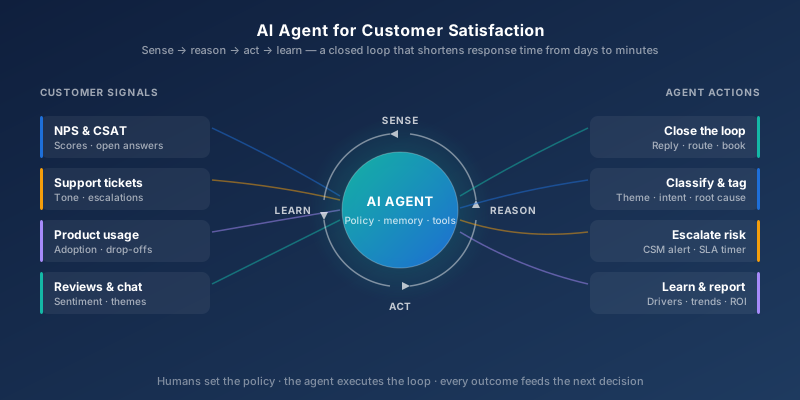
An AI agent is a system that can independently sense, reason and act within a defined mandate. Three properties set it apart from a chatbot:
- Memory: It remembers prior interactions, the customer's history and your business rules.
- Tools: It has access to the CRM, survey platform, ticket system, calendar and email. It can read and write, not just generate text.
- Mandate: It has a policy that defines which actions it may take alone and which require human approval.
A chatbot answers questions. An AI agent does work. The difference is fundamental.
A chatbot says: "I can see you're unhappy. Would you like to talk to an agent?" An agent says nothing. It has already created a task for the CSM, rated the risk as high, proposed 15 minutes in the calendar and drafted a confirmation to the customer that an advisor will call within two hours.
The Five Places Where Agents Actually Move Satisfaction
Not every part of the CX stack is equally ready for agentic AI. Five use cases consistently deliver value in the programmes we work with.
1. Classifying and Theming Open-Text Responses
The most under-used data point in most CX programmes is the open-text answer. It contains the reasons, but it rarely gets read systematically.
An agent can tag every open-text response by theme, sentiment, intent and root cause as it arrives. That makes it realistic to run systematic open-text analysis weekly instead of quarterly. How that tagging becomes urgency- and account-weighted routing is covered in AI text analytics for customer feedback.
Start here. It is the area with the lowest risk and the highest value.
2. Prioritising and Routing Feedback
Not all feedback is equally critical. A Detractor on one of your largest contracts complaining about an integration issue is not the same case as a Passive complaining about a button colour.
An agent can score each piece of feedback on (a) churn risk, based on the customer's health score, (b) commercial value, using the same account-weighting logic covered in account-based CX, and (c) urgency, then route it to the right owner with the right SLA. Without that, the CSM inbox is as full of noise as it is of critical items.
3. Preparing the Loop on Detractors
The most direct value point. The agent can:
- Read the Detractor response and summarise it
- Pull the customer's history from the CRM, support and the product
- Draft a reply based on earlier close-the-loop conversations that worked
- Prepare a confirmation to the customer with a proposed follow-up slot
- Create a task for the CSM with context, risk score and suggested talking points
Note the word prepare. For the first 90 days a human approves every message that leaves the building (see the mandate table below). The agent does not run the conversation. Closing the loop must be human, but the preparation does not have to be. For the human half of that work, see NPS detractor recovery.
4. Predicting Churn and Risk
Once the agent has 6 to 12 months of historical data, it can start to predict. Which customers are trending towards Detractor? Which will fall below a critical health score threshold in the next 60 days?
This is not a new capability. Key driver analysis and customer health scoring have delivered it for years. The difference is that the agent can run the prediction continuously, at individual account level, and tie it to actions. A red flag is not just a number on a dashboard. It is a task in a CSM's queue. One early place this pays off is onboarding: an agent watching first-value milestones can flag a stalled new account before anyone notices the survey that never got answered, the non-event trigger described in the B2B onboarding survey.
5. Summaries and Executive Reporting
The agent can draft quarterly NPS reports, driver analyses and executive summaries across both quantitative and qualitative data. The CX team then spends its time deciding and acting instead of assembling slides.
Reference Architecture
An agent for customer satisfaction typically consists of four layers:
| Layer | Responsibility | Example components |
|---|---|---|
| Data | Collect and normalise signals | Survey platform, CRM, support, product analytics, sentiment API |
| Reasoning | Understand, classify, prioritise | LLM, classifiers, rules, prompt library |
| Action | Execute tasks via tools | CRM API, calendar, email, ticket system, survey follow-up |
| Governance | Manage mandate, quality and audit | Guardrails, human-in-the-loop, QA sampling, logging |
The fourth layer is what separates a toy from production. Without governance the agent becomes either too cautious (and delivers no value) or too boundless (and generates customer complaints faster than it resolves them).
- Governance
- DataCollect and normalise signals
- ReasoningUnderstand, classify, prioritise
- ActionExecute tasks via tools
Adoption Is Accelerating. So Is the Cancellation Rate.
Two numbers describe the same 12 months, and both are worth reading with their small print.
Salesforce's State of Service: AI Agents Edition (3,075 customer service professionals, fieldwork 9 March to 4 April 2026) reports that 66% of service organisations now use agentic AI, up from 39% in 2025. That is the 1.7x jump you see quoted. The same report says 70% of organisations with AI service agents see measurable value within 60 days, and ranks customer satisfaction first among the KPIs that improved, ahead of productivity, handle time, retention and first-response time. Two cautions. Salesforce sells agents, and the figures are what respondents report, not measured outcomes. "Measurable value" is not defined.
At the same time, Gartner predicted on 25 June 2025 that over 40% of agentic AI projects will be cancelled by the end of 2027, because of escalating costs, unclear business value or inadequate risk controls. Gartner's January 2025 poll of 3,412 webinar attendees found 19% had made significant investments in agentic AI, 42% conservative ones and 8% none, with the remaining 31% waiting or unsure. Gartner also flags "agent washing", where vendors rebrand chatbots, assistants and RPA as agentic AI, and estimates that only about 130 of the thousands of vendors claiming agentic AI are real.
Neither number is wrong, and they do not contradict each other. One counts who says they use agents. The other predicts who will still be running them. The gap between the two is where discipline lives: teams that treat the agent as a scoped programme with an evaluation set, guardrails and an owner, versus teams that treat it as a platform purchase. That is why Steps 3 and 4 below matter more, not less, as adoption speeds up.
- 202539%
- 202666%
- Significant investment19%
- Conservative investment42%
- No investment8%
- Waiting or unsure31%
Do Not Fund the Agent With Headcount
This is the part of the business case most vendors skip, and the one we would argue hardest about. An agent that reads, classifies and drafts looks like a way to need fewer people. In B2B CX it is the wrong promise.
Gartner surveyed 275 service and support leaders in July and August 2026 (press release 5 November 2026). Only 21% said they had reduced human agent headcount because of AI, and those that did cut an average of 16.7% of the workforce over the previous 18 months. Seven percent had already rehired human workers after earlier reductions, and 11% planned to within 18 months. Gartner's analysts describe a "cut fast, rehire later" trap, and Gartner has predicted (February 2026) that half of the companies that cut customer service staff because of AI will rehire by 2027. The survey covers AI and GenAI in service organisations in general, not agents for NPS follow-up specifically.
Customers point the same way. In a Gartner survey of 3,566 customers (B2B and B2C combined, no split published, press release 4 August 2026), 87% said companies using GenAI for customer service must provide access to a human agent.
For a B2B team with a few hundred key accounts, the arithmetic is even less forgiving. Your CSMs are the relationship. If the agent buys them back the hours they now spend on admin, and they spend those hours on Detractor conversations, you move satisfaction. If the agent is used to shrink the team, you remove the people who hold those conversations and keep the part that only prepares them. Measure the agent on close-the-loop rate, time to first contact and recovery rate. Leave headcount out of the case.
- Have cut human agents because of AI21%
- Have already rehired after cuts7%
- Plan to rehire within 18 months11%
How to Implement an AI Agent in Practice
Step 1: Define the narrow use case
Pick one clearly scoped problem. For example: "Every NPS Detractor in our largest customer segment must receive a qualified summary and a calendar proposal for a CSM within 4 hours."
Avoid broad mandates like "handle all customer feedback". That is how projects fail.
Step 2: Map the data and systems
Which systems does the agent need access to? Typically the survey platform, CRM, calendar, email and a place to log its actions. Who owns each system? Who approves the API integration? Which customer data may the agent see at all? Settle that with your data protection lead before the pilot, using the same data-minimisation logic as in GDPR and customer feedback in B2B.
Step 3: Define the mandate and guardrails
Three levels of autonomy:
| Level | Example | Human-in-the-loop |
|---|---|---|
| Read | Classify responses, summarise, suggest | No, the agent reads and proposes |
| Write internally | Create tasks, tag feedback, update health score | No, within defined rules |
| Write externally | Send email to customer, book meeting | Yes, approved by a human for the first 90 days |
Start conservatively. Expand once the error rate is documented as low.
Step 4: Build the evaluation set before deploying
Collect 50 to 100 historical feedback cases where you know the correct outcome. Run the agent against them. Measure:
- Classification accuracy: Does it hit the right theme and sentiment?
- Prioritisation: Does it escalate the cases that actually ended in churn?
- Action quality: Is its draft something a CSM could send?
Without an evaluation set you are running blind. This is the step most often skipped. (The case counts, pilot length and sampling rates in this guide are our recommendations from practice, not benchmarks from a study. Adjust them to your volume.)
Step 5: Pilot on a single segment
Run the agent on one region, segment or channel for 4 to 8 weeks. QA-sample 10 to 20% of all actions. Measure:
- Time to first contact on Detractors
- Close-the-loop rate
- Error rate on agent actions
- Customer complaints or escalations related to the agent
Step 6: Scale or stop
If the pilot's KPIs are green, expand scope and autonomy gradually. If not, stop. An AI agent that delivers poor results is more expensive than no agent, because it shifts risk from people to systems without shifting accountability.
A Worked Example (Hypothetical)
The numbers below are an illustration built on assumptions, not a measured result from a customer. They show how to size a pilot before you start.
Nordika A/S is a Nordic B2B software company with about 900 customers and a four-person CSM team. Assume that each quarter its NPS programme produces 40 Detractor responses, that today about 12 of them get a personal reply within a week, and that preparing one Detractor case by hand (reading the response, pulling CRM and ticket history, drafting a reply) takes a CSM about 30 minutes.
The pilot mandate is narrow: for every Detractor, the agent produces a summary, a risk rating and a drafted reply within five minutes, and creates a CSM task. High-risk cases also get a proposed calendar slot. A CSM approves and sends every external message.
| Assumption | Today | Pilot target |
|---|---|---|
| Detractor responses per quarter | 40 | 40 |
| Detractors with a personal reply within a week | 12 | 40 |
| Preparation time per case | 30 minutes | 5 minutes of review |
| CSM preparation hours per quarter | 20 hours | about 3.3 hours |
Under these assumptions, the pilot frees about 16 CSM hours a quarter and, more importantly, lets the team reach all 40 Detractors rather than 12. The 16 hours are small. The coverage is the point. Whether recovery rates actually improve is what the pilot is for, and nothing in this table claims they will.
Note what the example does not assume: that the NPS moves because of the agent. It moves, if it does, because the CSM team finally has the time and structure to have the conversations they should have been having all along.
Common Pitfalls
The agent should do everything. The broader the mandate, the more opaque it becomes. Start with one use case, document the effect, expand.
Automating a loop that never ran. An agent speeds up a process. If nobody follows up on Detractors today, it will produce faster summaries that nobody acts on. If your programme sits at level 2 on the CX maturity model, collecting feedback without acting on it, the agent automates the gap rather than filling it. Fix the owner and the routine first, with close the loop for NPS as the template.
No evaluation set. Without known-good answers you cannot measure quality. Without quality metrics the agent becomes either feared or over-trusted, rarely used well.
The agent answers customers directly from day one. High risk, low trust. Start internally. Let the agent prepare conversations before it runs them. Forrester's 2026 B2C predictions expect a third of brands to erode customer trust by putting AI self-service in front of customers before it is ready. That is a consumer forecast, but the mechanism travels, which is why great B2B customer service keeps a fast, visible escalation path to a named human.
You assume your customers trust the agent because your team does. Trust in AI agents grows with hands-on experience, and that creates a blind spot. Salesforce reports that 65% of customer service professionals say their customers fully trust AI, and cites Metrigy for a figure of 44% of consumers who trust AI to handle their service needs. The 44% is a consumer figure, and we could not verify it in Metrigy's own published material, so read it as indicative. The direction is the point: your team's confidence in the agent is not the same measurement as your customer's. Build in a visible, one-click path to a human for every AI-led interaction.
No audit log. When something goes wrong (and it will), you need to see exactly what the agent did and why. Log every input, decision and action from day one.
No owner. An agent without an accountable person becomes nobody's. Define who owns its performance, its guardrails and its audits, the same governance question we cover in CX governance. If nobody in your organisation is accountable for customer experience, an AI agent will not fix that. It will make the gap move faster. For the wider picture of AI accountability in CX, see AI and customer experience in 2026.
- Service professionals who say their customers fully trust AI65%
- Consumers who trust AI to handle their service needs (Metrigy, via Salesforce)44%
Relationship to Existing CX Metrics
The agent does not replace your metrics. It accelerates them.
| Metric | Agent's role |
|---|---|
| NPS | Classifies responses, prioritises follow-up, summarises drivers |
| CSAT | Real-time tagging of negative responses, automatic escalation |
| CES | Identifies friction points and repeat complaints |
| Health Score | Updates the score with live signals, triggers action on red accounts |
The agent is the glue between measurement and action. Without it, most close-the-loop programmes fall apart on volume. With it, you can scale systematic follow-up across the entire customer base, as long as people still hold the conversations.
Getting Started
You do not need an agentic platform on day one. Most of the companies we work with start with:
- One narrow use case, typically open-text classification or close-the-loop preparation for Detractors
- An evaluation set of 50 to 100 historical cases
- A 4 to 8 week pilot on one segment
- Clear governance: who owns it, who QA-samples, who escalates
When that runs well, you widen the mandate. Not before.
An AI agent is not a magic solution. It is a discipline, the same kind as survey design, close-the-loop or customer health scoring. The difference is that the discipline can now be executed in real time and at scale.
And as always: the technology is the easy part. Closing the loop with the customer is still what determines whether customer satisfaction actually moves. Start there.
Frequently asked questions
What is the difference between an AI agent and a chatbot?
A chatbot follows a script or an LLM prompt and responds reactively. An AI agent has memory, access to tools such as the CRM, survey platform and ticket system, and a defined mandate. It can read an NPS response, decide that it is a Detractor with churn risk, create a task for the CSM, draft a follow-up and update the customer's health score. The difference is autonomy and action, not just dialogue.
Can an AI agent replace our Customer Success team?
No, and you should not plan for it. The agent takes routine work such as classifying feedback, drafting acknowledgements, prioritising the inbox and preparing briefings. Empathy, difficult negotiations and strategic relationships stay human. Gartner's November 2026 survey of 275 service leaders found that only 21% had cut agent headcount because of AI, and Gartner predicts that half of the companies that do will rehire by 2027.
How do we stop the agent from responding incorrectly to customers?
Use three mechanisms. Scope: start with internal actions such as classify, route and prioritise before the agent writes to customers. Guardrails: define which actions it may take alone and which need approval, and route Detractors and key accounts through a human. QA sampling: review 10 to 20% of the agent's actions for the first 90 days, and widen the mandate only once your documented error rate is low enough for your risk appetite.
How much data do we need before an AI agent makes sense?
Less than you might think for classification, where an LLM-based agent can categorise open-text responses well from a handful of examples. For prediction of churn risk or next-best-action you should have at least 6 to 12 months of historical feedback tied to business outcomes. Start with classification and routing, and add prediction once the data foundation is mature.
How do we measure ROI on an AI agent for customer satisfaction?
Use four KPIs: time to first contact on Detractors, close-the-loop rate (the share of Detractors actually contacted), recovery rate (the share that move to Passive or Promoter at the next measurement) and CSM hours freed for conversations. Connect it to revenue impact by comparing retention on accounts the agent touched with a control group. Do not use headcount reduction as the measure.
Does the fast adoption of AI agents mean we are already behind if we have not started?
No. Salesforce reports that 66% of service organisations use agentic AI, up from 39% a year earlier, but that is self-reported adoption from a vendor survey. Gartner still expects over 40% of agentic AI projects to be cancelled by the end of 2027, mainly for cost, unclear value and weak risk controls. The bigger risk is starting broad and unscoped, so follow the narrow-use-case-first sequence rather than matching a headline adoption number.
Do customers accept AI agents in customer service?
They accept them when a human stays reachable. In a Gartner survey of 3,566 customers (B2B and B2C combined, August 2026), 87% said companies using GenAI for customer service must provide access to a human agent. In B2B, where you serve few accounts with long relationships, give every AI-led interaction a visible path to a named person.

Written by
SurveyGauge Team
The advisors and developers behind SurveyGauge. We run customer satisfaction programmes for B2B companies, from 20 key accounts to global banks.