
Close the Loop: The Complete Guide to NPS Follow-Up [2026]
Most B2B companies that measure NPS never act on it. This guide breaks down the 48-hour rule for Detractors, segment-specific workflows for Detractors, Passives and Promoters, the CRM integration that makes it stick, and the four numbers that prove it is working.
![Close the Loop: The Complete Guide to NPS Follow-Up [2026]](/img/knowledge/close-the-loop.svg)
- Most B2B companies that measure NPS treat it as a scorecard, not a system: they collect scores but rarely act on them, and that gap is where retained revenue quietly disappears.
- Speed decides everything for Detractors. Contact them within 48 hours, before the memory of the problem fades and before the customer concludes you were not listening.
- Passives, not Detractors, are the biggest missed opportunity. Moving one Passive from a 7 to a 9 has the same net effect on NPS as saving a Detractor, and usually takes one well-asked question.
- Counterintuitive but well documented: a customer whose real problem gets fixed fast often ends up more loyal than one who never had a problem at all. That is the service recovery paradox.
Contents8 sections
What Does Closing the Loop Actually Mean in an NPS Program?
Closing the loop means contacting every person who responds to an NPS survey, not just the unhappy ones, and turning their score into a specific action: an acknowledgment, a resolved issue, a thank-you, or a nudge toward something better. Four steps repeat across every mature program: acknowledge the feedback arrived, understand what is actually behind the number, act on it, and confirm back to the customer what changed.
Most companies stop after step one, if they get that far. CustomerGauge's 2026 NPS Benchmark Report: Decade Edition, based on 340 B2B CX programmes surveyed between May and July 2026 (47 questions, 10,139 data points), found that 70% of B2B companies still do not connect their experience data to revenue at all. Closing the loop on a single account is the smallest, most concrete version of that same gap: you have the signal, and you do not use it.
Here is the part worth arguing with: an NPS program without a closed loop is not a CX program. It is a scorecard. You can watch the number move up or down for years and never know why, because the "why" lives in the comments nobody called back about.
If you are new to NPS as a metric itself, start with our guide to what NPS is and how to calculate it before working through this one. For the shorter introduction to the inner loop, the outer loop and the service recovery paradox, see Close the Loop: What Is It, and How Do You Do It?.
The 48-Hour Rule for Detractors
Speed is the single biggest lever in close-the-loop, and it is not close. Contact a Detractor within 48 hours and you are still inside the window where the experience is fresh enough for the customer to describe exactly what went wrong, and where a fast callback reads as "someone noticed" rather than "we are catching up." Wait a week and both signals are gone, whatever you say on the call.
This is why B2B companies CustomerGauge highlights as benchmark performers, such as gifting-platform Alyce, standardise on closing the loop with all Detractors inside 48 hours rather than treating it as an aspiration. It is also the mechanism behind the service recovery paradox: a customer whose real problem gets fixed fast, visibly, and with an apology, often ends up more loyal than one who never had a problem in the first place. That is the counterintuitive part CX teams underuse: a good recovery is not just damage control, it is a loyalty-building event you cannot manufacture any other way.
Three things make the 48-hour SLA work in practice: automated alerting the moment a Detractor score lands, a hard escalation rule (unowned after 24 hours goes to the manager, unowned after 36 goes to the CX lead), and a visible SLA metric leadership actually looks at. If universal 48-hour coverage is not realistic on day one, prioritise by account value, not by score, and close the loop on your top-tier accounts first. That is what account-based CX means in practice: not a separate program, just the right sequencing of the one you already have.
Detractors, Passives and Promoters Need Different Workflows
Treating every NPS response the same way is the fastest way to waste the signal. Detractors, Passives and Promoters need different owners, different timelines and different scripts.
| Segment | Score | Primary owner | Timeline | Goal |
|---|---|---|---|---|
| Detractor | 0-6 | Account manager or CSM | Contact within 48 hours | Understand root cause, resolve, recover the relationship |
| Passive | 7-8 | CSM or marketing | Contact within 5 business days | Find the one gap that would make them a 9 or 10 |
| Promoter | 9-10 | CSM, marketing or AM | Contact within 7 days | Thank them, activate as a reference or advocate |
Detractor calls need a person with the authority to actually fix something, not just apologise and "pass it on." Listen first, ask what specifically happened, restate it back, commit to one concrete action with a date, and follow up on that date. Automated emails to a customer who just gave you a 2 tend to make things worse, not better.
Here is the part most B2B teams get backwards: Passives get the least attention and offer the most upside. Moving one Passive from a 7 to a 9 has the same net effect on your NPS as rescuing a Detractor, and it usually takes one well-asked question instead of a service recovery. "What would it take for us to earn a 9 or 10 from you next time?" costs nothing and surfaces gaps Detractor calls never will, because Passives are not angry enough to complain unprompted.
Promoters still need a human touch, even though the workflow here can lean more on templates: a genuine thank-you, an invitation to leave a review or join a reference program, and for your top accounts, a call from the account manager rather than an automated email. A Promoter who never hears from you again is a Promoter you are slowly losing.
Connecting Close the Loop to Your CRM
A close-the-loop process that lives in spreadsheets collapses within weeks: someone gets busy, tasks stop getting created, and the whole thing quietly reverts to "we measure NPS" without the follow-up. The minimum viable integration between your survey platform and your CRM needs four things: responses sync into the CRM within minutes and attach to the account record, not just the contact; segment rules auto-create a follow-up task with the right owner, priority and due date; unowned tasks escalate automatically on a fixed clock; and every call, email and resolution gets logged against the original response so the next person, or the next survey, has the history. Without that last piece, the same issue gets rediscovered every quarter instead of tracked to resolution.
- 1Customer answers the NPS survey
- 2Score is segmentedDetractor, Passive or Promoter
- 3CRM task is createdRight owner, priority and due date
- 4Personal follow-upCall or email, by segment
- 5Action and resolution
- 6Confirm back to the customerWhat changed
- 7Re-survey60-90 days later
The Outer Loop: From Individual Fixes to Systemic Change
Everything above is the inner loop: one customer, one issue, one resolution. Mature programs also run an outer loop, where CX teams aggregate the root causes behind every Detractor and Passive conversation on a monthly basis and look for the pattern underneath the individual complaints. If fifteen accounts mention the same onboarding gap in one quarter, the fix is not fifteen phone calls, it is a product or process change with a named owner and a deadline. Key driver analysis is the natural next step here: it tells you statistically which of those recurring themes actually move the score, rather than which one simply got mentioned the most this month.
The step almost everyone skips is closing the loop back to the customer base as a whole: telling people what changed because of what they told you. "Earlier this year, several of you told us onboarding took too long. We shortened it." That single sentence, sent to the people who raised the issue, is what turns a survey into something customers believe is worth their time to keep answering.
What Goes Wrong
The recurring mistakes look different on paper but come from the same root cause: treating close the loop as a task instead of a discipline. Confining it to the support team leaves product, finance and leadership out of the outer loop entirely, so the same root causes resurface every quarter. Automating the Detractor conversation itself, rather than the infrastructure around it, reads as indifference to the one group of customers who most need to feel heard, which is the opposite of what detractor recovery requires. Following up without the authority or intent to actually resolve anything, the "I'll pass it on" call, often does more damage than not calling at all. And skipping the re-survey after resolution means you never find out whether any of it worked, which is how a close-the-loop program stays a story instead of becoming a number on a dashboard.
Measuring Whether Close the Loop Is Actually Working
Track four things, not just the average NPS score: contact rate (the share of Detractors reached inside your SLA window), resolution rate (the share of logged issues actually resolved to the customer's satisfaction, not just contacted), score recovery rate (the share of Detractors who move to Passive or Promoter at the next survey, typically measured 60-90 days out), and the churn delta between contacted and non-contacted Detractors over the same period. That last one is the number that gets close-the-loop funded, because it converts a CX activity into a retained-revenue figure a CFO will read. For the full model connecting satisfaction data to revenue, see Customer Satisfaction and Revenue.
To illustrate what this looks like in practice, here is a hypothetical quarter for Nordika A/S, a fictional B2B software company used for illustration throughout SurveyGauge's content:
| KPI | Q1 (hypothetical) | Q2 (hypothetical) |
|---|---|---|
| Contact rate within 48h | 68% | 84% |
| Resolution rate | 51% | 66% |
| Score recovery rate | 19% | 31% |
| Detractor churn vs. non-contacted | roughly even | meaningfully lower |
The trend line, not the absolute numbers, is the point: a close-the-loop program that is actually running should move all four in the same direction within two to three quarters. If it is not, the process needs attention before the survey does.
- Contact rate within 48h+16%Q168%Q284%
- Resolution rate+15%Q151%Q266%
- Score recovery rate+12%Q119%Q231%
Where This Fits Into a Broader CX Program
Close the loop is the mechanism, not the strategy. It sits inside a wider CX program alongside transactional vs. relational NPS measurement (deciding when you ask), account-based CX (deciding who gets prioritised), and a key driver analysis that tells you what to fix at the system level. None of that matters if the individual Detractor never gets a call back. This is also, practically, where a combined platform-and-advisory model earns its place: the technology can automate the alerting and the escalation clock, but the judgment calls, who to prioritise, what "resolved" actually means for a given account, how to read the outer-loop pattern, are the part software alone does not do. That is the work worth having a partner for, not just a dashboard.
Want to see how SurveyGauge runs the loop with you? See pricing or book a demo.
Frequently Asked Questions
Ready to know what your customers actually think?
SurveyGauge helps Nordic B2B companies move from gut feeling to data-driven CX decisions.
SurveyGauge Team
Customer Experience Experts
SurveyGauge-teamet hjælper virksomheder med at måle og forbedre kundetilfredshed via professionelle surveys, analyser og rådgivning.
You might also be interested in
View all articles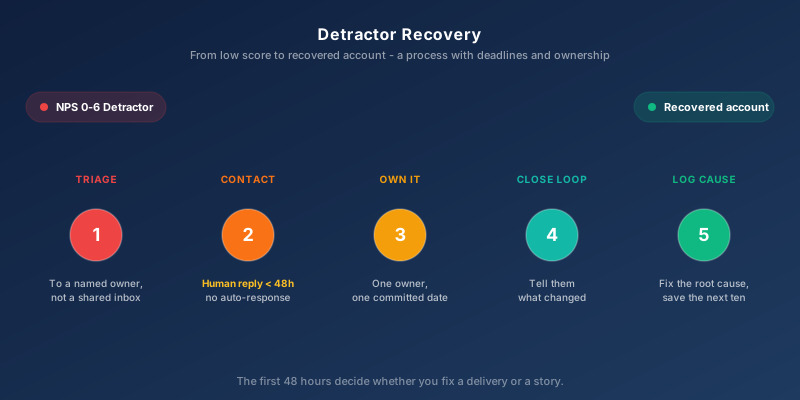
Detractor Recovery: The Playbook for Saving Unhappy B2B Accounts
A detractor is not a lost account. It is the most recoverable revenue you have, but only if you treat recovery as a process with deadlines and owners, not a goodwill gesture. Here is the playbook.
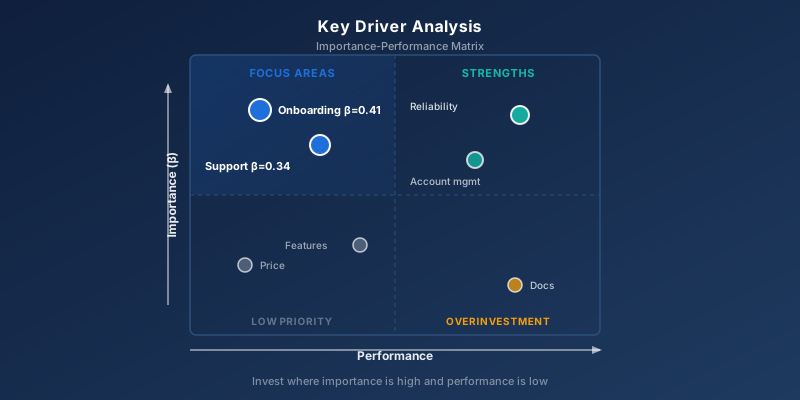
Key Driver Analysis: Find Out What Actually Moves Your NPS
NPS tells you THAT something is wrong. Key driver analysis tells you WHAT. Here is the method that turns a score into a prioritised action plan.
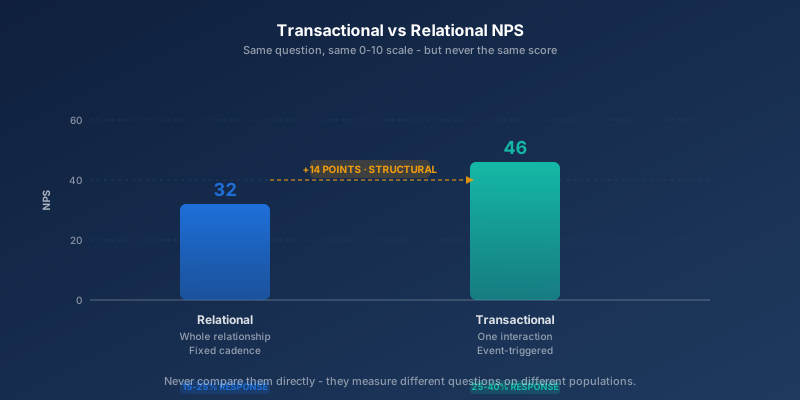
Transactional vs. Relational NPS: When to Use Each in B2B
Relational NPS tells you if the relationship is healthy. Transactional NPS tells you where a process broke. Most B2B companies measure one, too rarely, and then compare two numbers that were never comparable.